
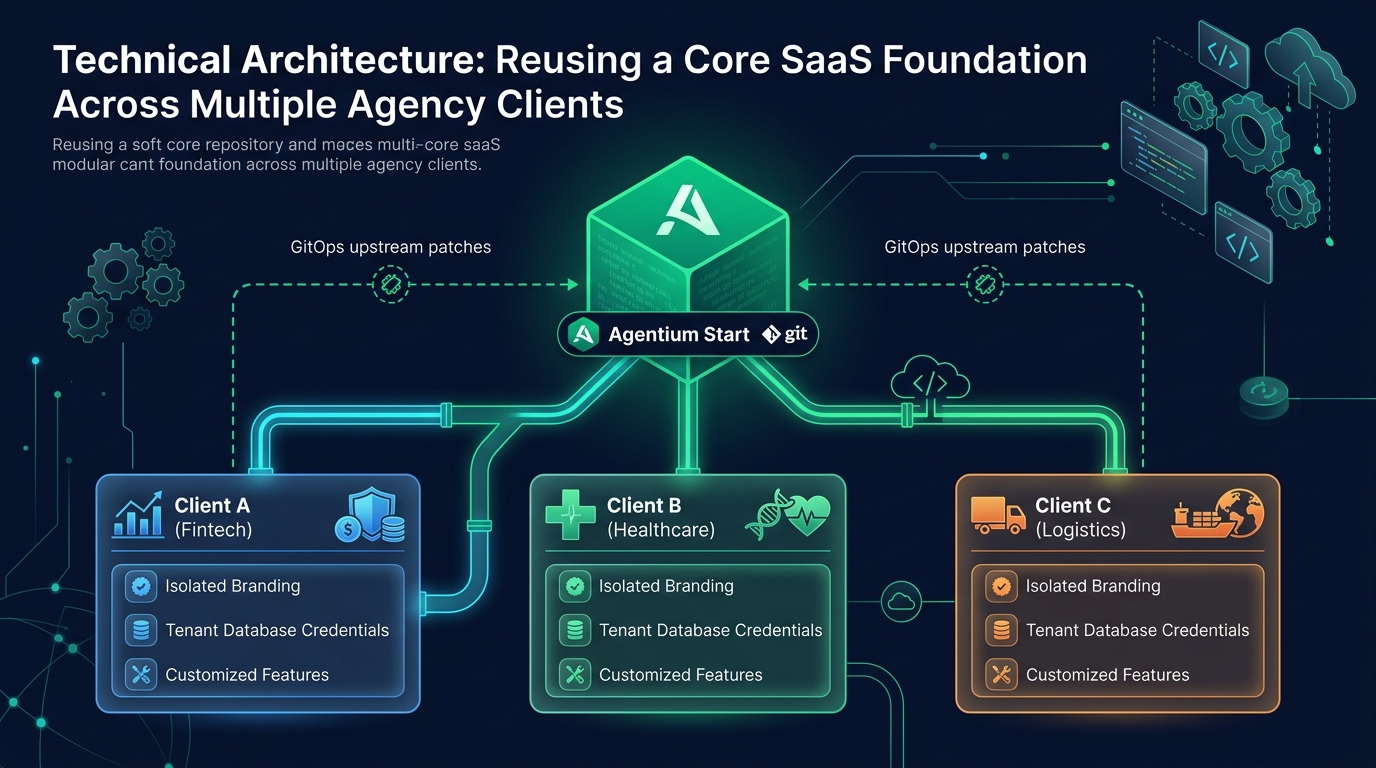
Agencies can reuse a SaaS foundation by maintaining a clear baseline for common application behavior and treating each client application as a deliberate implementation of that baseline. Reuse works best when identity, workspaces, configuration, billing integrations, and operating conventions remain understandable across projects.
The aim is to reduce repeated foundational decisions while preserving each client's actual workflow. A reusable base should not force unrelated clients into the same permissions, data model, or release schedule.
Define what belongs in the shared baseline
List the capabilities that recur across your agency's applications. These may include sign-in, organization membership, permission checks, notification infrastructure, form conventions, logging, and deployment configuration.
Separate those from business rules. A property inspection workflow, a training portal, and a supplier review application may share account foundations while requiring different statuses, ownership relationships, and approval behavior.
Write a short rule for when code returns to the baseline. A generic bug fix or improved input component may qualify. A single client's custom approval ladder may belong only in that client's application until you have evidence of a reusable requirement.
This keeps the base from becoming an accumulation of client-specific switches that nobody can safely remove.
Confirm the commercial delivery boundary
Before using a purchased foundation for client work, check the edition's developer access, client-delivery terms, source handling, update period, and support scope. The client agreement and foundation license should describe compatible responsibilities.
The Agentium Start pricing page distinguishes its Core and Agency editions and links to the commercial terms. Use those current terms when deciding who may access the source and how completed applications can be handed over.
Do not promise rights or support that your agency has not secured. Clarify whether the client receives a completed application, its operating source, ongoing maintenance, or a combination. Treat any setup service and later custom development as explicit delivery scope.
Choose a repository and version strategy
Maintain a private, reviewed baseline and record the starting version used for each client project. Keep a simple register of deployed application versions, major customizations, provider choices, and maintenance ownership.
Repository templates can help create new projects, but copying files is only the starting operation. GitHub's template documentation explains that a repository created from a template starts with its own initial commit rather than the template's full history.
Plan how later fixes will move into client applications. Depending on your architecture, that may involve shared packages, selected patches, or carefully reviewed merges. Choose one approach your team can maintain rather than assuming a copied starter will update itself.
Keep client secrets and production data out of the reusable baseline. The next project should begin with safe examples and explicit configuration requirements.
Separate configuration from custom behavior
Branding, application names, enabled providers, and plan labels may be configuration. Domain decisions usually deserve code with their own tests and documentation. Avoid expressing complex business behavior through increasingly opaque configuration files simply to claim that all clients share one application.
Consider three hypothetical projects: a studio client portal, a facilities issue tracker, and a training company dashboard. All may use workspaces and members. The studio needs version-specific approvals, the facilities product needs location-based assignments, and the training dashboard needs enrollment and completion records.
Reuse the common access and application conventions, then implement those domain modules explicitly. When a client requests an exception, determine whether it changes a reusable rule or just that product. Record the decision so the next developer does not have to infer it from conditional branches.
Review shared fixes in each affected application
Suppose your team finds a defect in how an expired invitation is displayed and accepted. Fix the baseline, add a meaningful regression check, and identify which client versions contain the affected behavior.
Then assess each application before applying the change. One client may have a custom invitation screen or identity integration. The shared fix still needs validation against those differences.
Track the rollout to completion with evidence of the affected workflow. Reusing a patch does not justify skipping review because the source is familiar. Equally, avoid retesting unrelated features without a concrete reason; focus on the changed behavior and the boundaries it touches.
This process turns maintenance into an explicit service capability. It also prevents the agency from remembering a fix in the latest project while older clients remain on a known problematic version.
Make operations and handover part of delivery
Agree who owns hosting accounts, domains, service credentials, backups, monitoring, and incident response. Client-controlled accounts can support a clear ownership arrangement when that is the agreed model, but they still require correct access setup and a usable handover.
Document the deployed components, configuration names, release process, database migration approach, and basic recovery procedures. Provide instructions that match the delivered version, including the client's custom modules.
Have the intended maintainer perform a small change or recovery exercise during handover. A document that nobody can follow does not establish operational independence.
Separate defects in the common foundation from client feature requests and provider-account issues in your support process. Clear categorization helps route the work and apply the correct commercial agreement.
Measure reuse by maintainability
Track whether your baseline reduces repeated decisions, whether new developers can understand projects, and how quickly you can identify which clients need an important fix. Use your own measured data if you later make efficiency claims.
Review the baseline periodically and remove obsolete assumptions through deliberate version changes. Keep examples and documentation aligned with the supported structure.
Agentium Start's capability catalog can serve as the initial scope reference when your agency adopts its foundation. Build a delivery process around that scope so each client receives a coherent application and a clear plan for its continued ownership.
Authority References & Sources: