
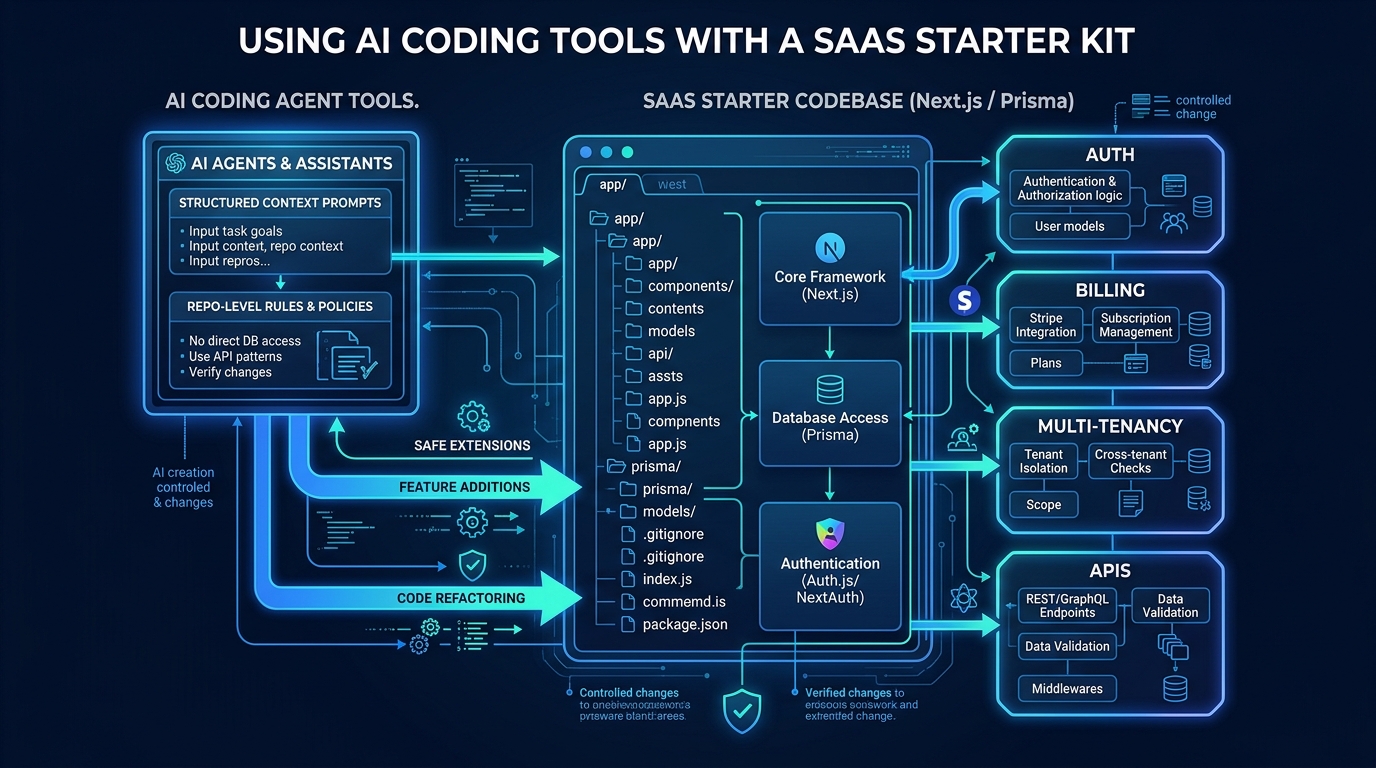
Use AI coding tools as part of a controlled change process for your SaaS starter. Give the tool a clear outcome, the relevant repository conventions, and specific acceptance criteria. Review the proposed approach, inspect the resulting changes, and verify the behavior that matters to customers.
A starter can provide consistent examples for the coding tool to follow. The benefit comes from preserving those patterns while adding your domain logic. Broad instructions to “build the whole product” make it harder to determine what changed and whether the existing foundation remains coherent.
Build a short application map
Before requesting changes, document where the important decisions live. Include the customer and workspace model, authorization entry points, database access conventions, billing rules, environment configuration, provider integrations, and test commands already present in the repository.
Name a representative existing feature the tool should inspect. If the application has a well-structured project flow, use it as a pattern for a similar business object. Explain which aspects are examples and which are required conventions.
Keep repository instructions factual and concise. GitHub's Copilot review documentation describes repository-wide and path-specific custom instructions. The broader practice applies across coding workflows: supply the context needed for the particular area being changed, and verify what your chosen tool actually reads.
Describe a bounded customer outcome
Consider a hypothetical SaaS that manages equipment service requests. You want to add an archive action for completed requests. A good task describes who may archive, which states permit it, what changes in list views, and whether archived records remain readable.
Specify that the action must use the existing workspace and permission helpers. Ask the tool to identify the relevant files and describe its plan before editing. Include existing behavior that must continue, such as viewing a historical service record from a saved link.
This gives the tool a constrained problem with a reviewable result. It also exposes missing product decisions. If nobody has decided whether archived requests can be restored, answer that question before implementation rather than allowing a generated interface to establish policy.
Separate discovery from implementation
First ask the tool to trace the existing workflow and report the relevant data model, checks, and user interface components. Compare that report with the code. Incorrect discovery is a reason to correct context before more files are changed.
Next request a small implementation plan. It should identify the new state or field, affected operations, visible behavior, and verification needed. Avoid unrelated cleanup in the same change unless it is necessary for correctness.
Then let the tool implement the agreed scope in an isolated branch or equivalent reviewable workspace. Keep generated changes small enough that a person can understand them. A large diff that happens to compile can conceal several unrelated decisions and make future fixes harder.
Review the boundaries that generation can miss
Trace the archive action from the browser to the server and the database. Check how the actor's workspace membership is established, whether the permission is enforced server-side, and whether the target request belongs to that workspace.
Inspect input validation and state transitions. A completed request may be archivable, while an active one should remain in the operating queue. Consider repeated submissions and two users acting on the same record.
Check generated dependencies, configuration fields, and migrations. Each should have a purpose you can explain. Review changes to common helpers carefully because an apparently local feature can affect other parts of the product.
AI review can provide another perspective, but the release owner should still understand the material behavior. A second automated opinion is useful evidence to assess, not proof that the change is correct.
Verify outcomes instead of accepting a success message
For the service-request example, verify that an authorized user can archive a completed record, the correct lists change, a direct historical link still behaves as intended, and another workspace cannot archive or read the record.
Add targeted automated checks for meaningful behavior and failure paths. Use the repository's real validation commands rather than commands invented by the coding tool. If a required check cannot run because configuration is missing, record the limitation clearly and complete the remaining authorized checks.
Read test results and inspect the running interface when the change affects a user flow. A report that says tests passed should identify which tests actually ran. Keep the final change description focused on the problem solved, resulting behavior, and relevant verification.
Keep development assistance separate from product AI
Using a coding assistant does not make the finished application an AI product. It also does not automatically supply an AI provider layer, evaluation process, usage metering, or a reliable end-user agent.
Agentium Start describes reviewed AI development recipes for extending its source foundation. Its AI-themed landing templates are page designs, with their implementation boundaries stated on the site. Use the recipes as a starting structure for development and scope any customer-facing AI behavior separately.
Review the source license and your coding-tool account settings before supplying proprietary repository material. Use the provider and repository controls appropriate to the code you are authorized to work on.
Preserve the result for the next change
After merging, update the small amount of documentation affected by the new behavior. Record new configuration requirements, meaningful domain rules, and any operating action introduced by the feature.
Keep a reliable reference implementation for future prompts. The archive workflow can become the pattern for another authorized state transition, provided its differences are made explicit.
Consult the Agentium Start documentation when extending its source kit. A consistent map, bounded tasks, and reviewed outcomes let AI coding tools contribute without making the application harder for its owner to understand.
Authority References & Sources: