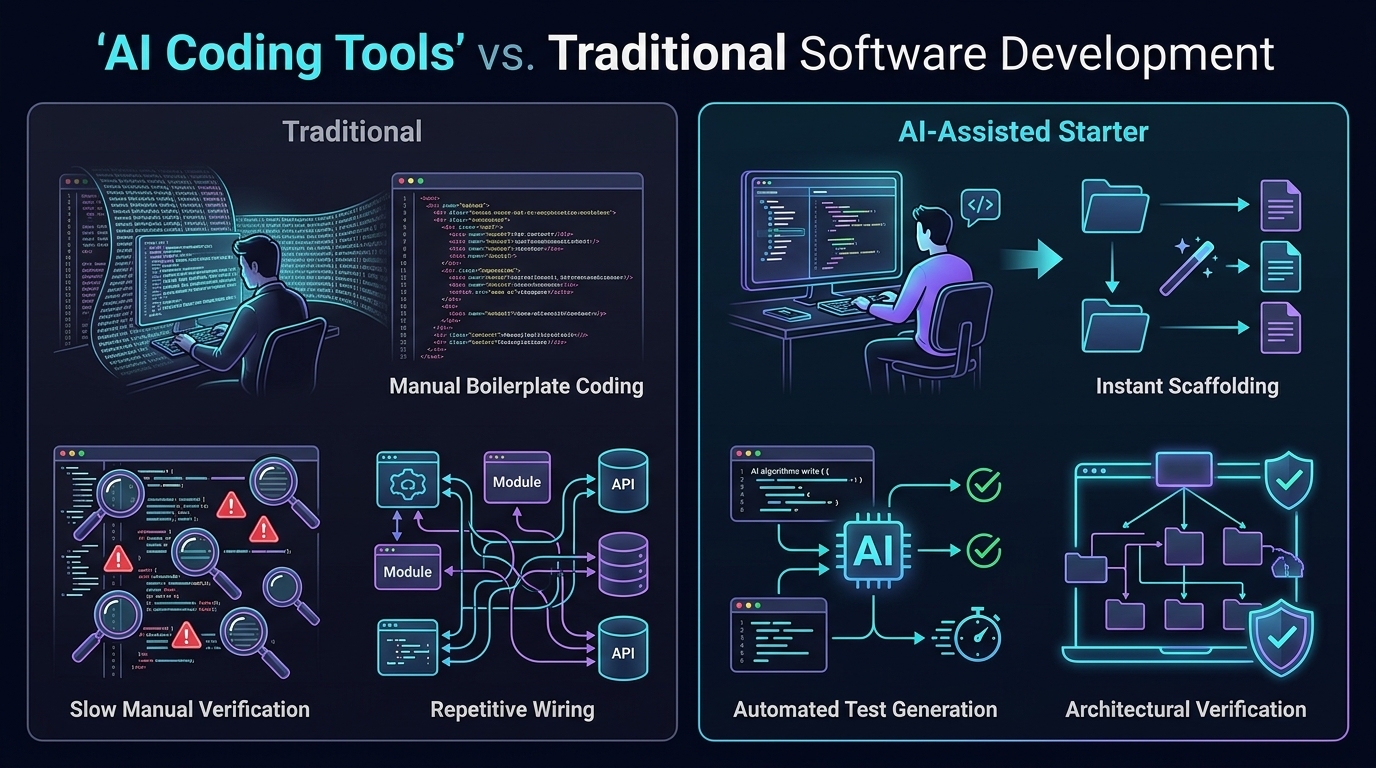
AI coding tools are changing how software teams write and maintain applications. But the comparison between AI-assisted and traditional development is not simply about which approach writes code faster.
Both approaches need clear requirements, suitable architecture, testing, and maintenance.
Traditional Development
Developers design systems, implement features, and validate behavior using established engineering practices. The process can be time-consuming, particularly when common infrastructure must be rebuilt for each project.
AI-Assisted Development
AI tools can accelerate scaffolding, routine implementation, refactoring, and documentation. They can also introduce defects, misunderstand requirements, or generate changes that do not fit the existing architecture.
Why the Foundation Matters
AI assistance is often more effective when the codebase has consistent patterns, clear module boundaries, and existing tests.
Instead of generating an entire application from scratch, developers can ask an agent to modify a known component and verify the result.
Choosing an Approach
Consider your team's expertise, security requirements, architectural constraints, and the complexity of the product.
The best workflow may combine human architectural decisions, AI-assisted implementation, automated verification, and careful review.
Conclusion
AI and traditional engineering are complementary. The objective is to improve the development process while maintaining control over correctness and quality.
Agentium Start supports this approach by offering a reusable B2B SaaS foundation that developers can extend with their preferred coding tools.