
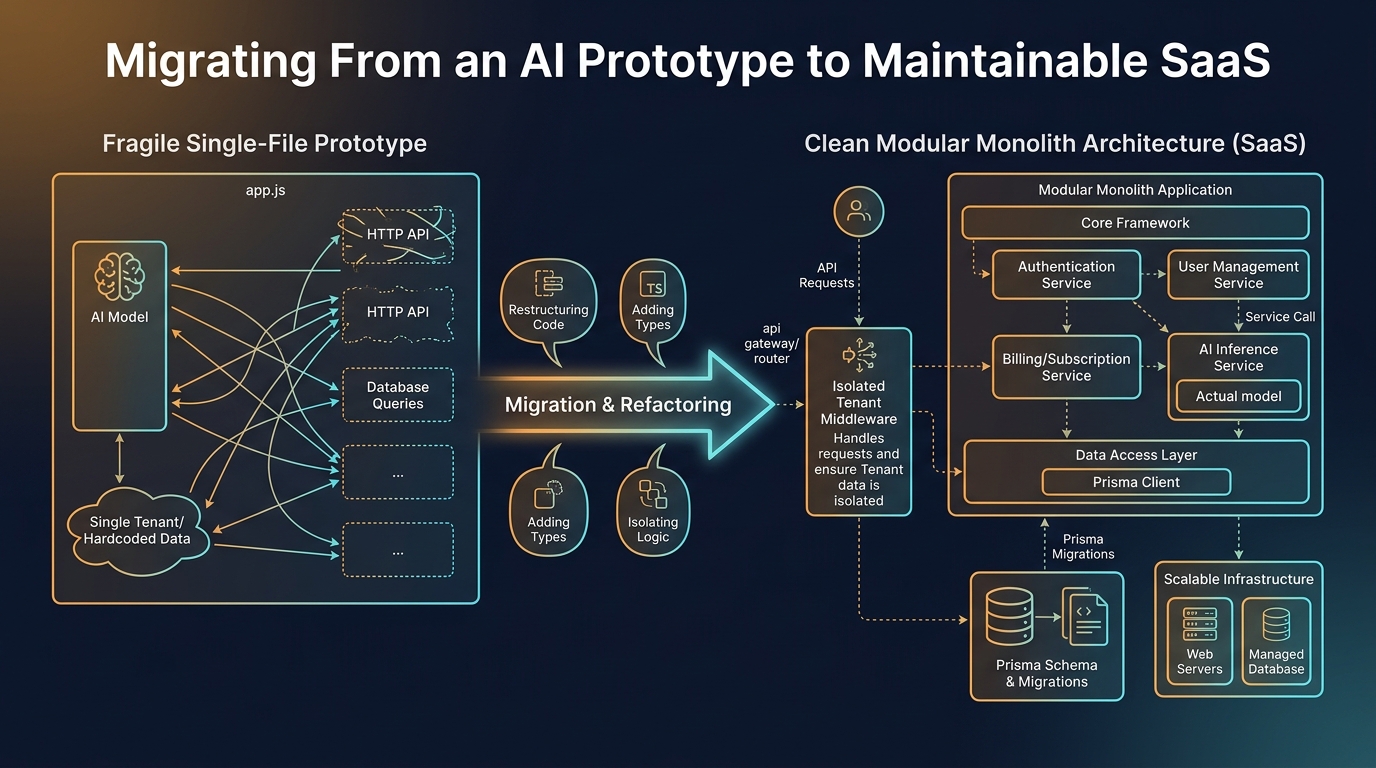
AI-generated prototypes are useful for exploring product ideas. But prototypes often lack the architecture, security controls, and operational processes needed for a maintainable commercial application.
Migration should begin with an assessment, not an immediate rewrite.
Audit the Existing Application
Document the current framework, dependencies, data model, authentication, external integrations, and important workflows.
Identify what works, what is missing, and which parts are difficult to maintain.
Establish the Security Requirements
Review authentication, authorization, tenant isolation, input validation, secrets handling, and access to sensitive operations.
Fix critical vulnerabilities before adding new features.
Choose an Architecture
Determine whether to refactor the prototype, introduce a structured foundation, or rebuild selected components.
The decision should depend on the cost and risk of preserving the existing implementation.
Migrate Incrementally
Prioritize core workflows and data integrity. Use automated tests to preserve expected behavior during changes.
Establish Operational Practices
Add configuration validation, logging, repeatable deployment, and appropriate backup and recovery procedures.
Conclusion
A successful migration turns a working demonstration into a system that can be understood, tested, and maintained.
Agentium Start provides a B2B SaaS source foundation that developers can evaluate as a starting point for new applications or selected rebuilds. Assess its architecture and feature scope before deciding whether it suits your migration.