
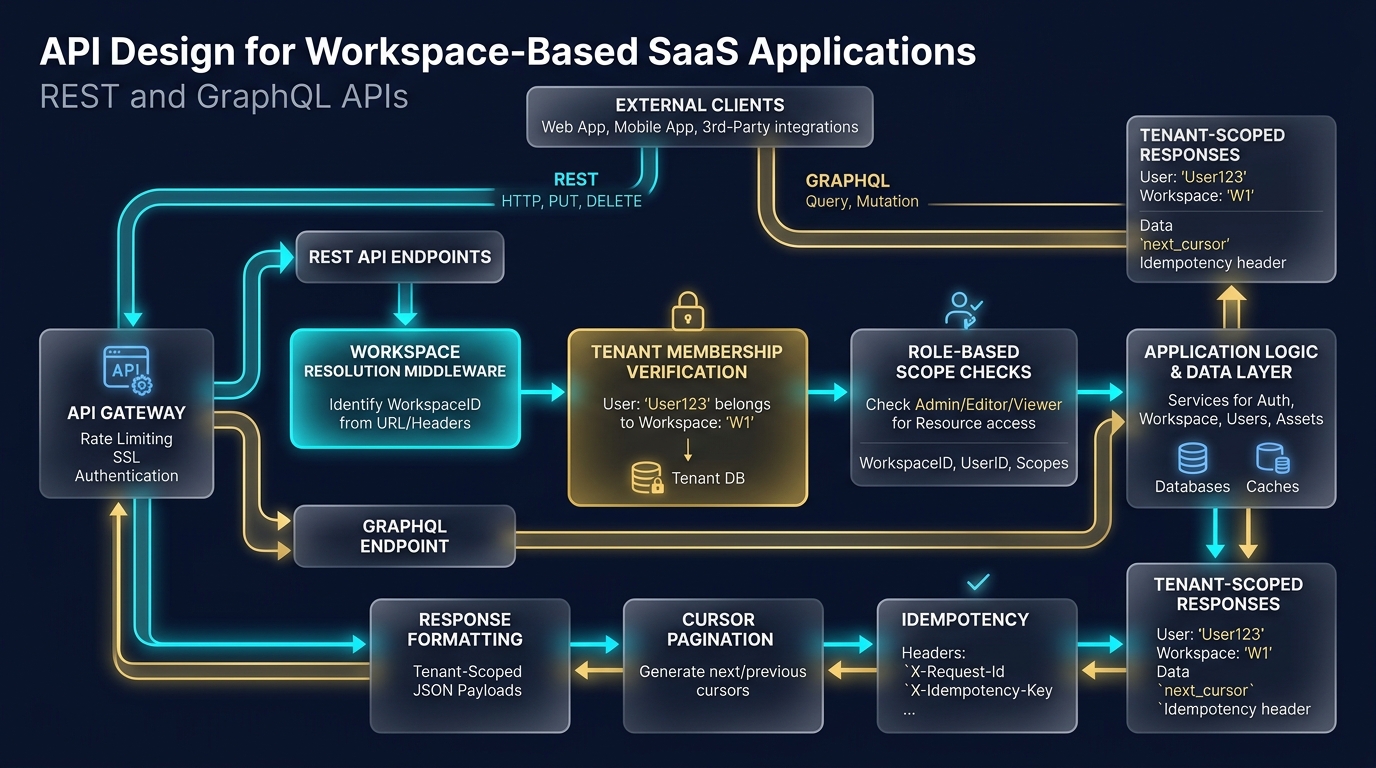
A workspace-based SaaS API should make the target organization explicit and verify that the caller can perform the requested action on the selected resource. Predictable URLs help developers understand the interface, but the security boundary lives in server-side authorization and tenant-scoped data access.
Design the API around stable business resources and clear operations. A small, coherent interface is easier to maintain than a collection of endpoints shaped independently by each screen in the dashboard.
Make workspace context explicit
An illustrative route such as /api/workspaces/{workspaceId}/projects/{projectId} communicates the intended relationship. Treat these identifiers as untrusted inputs. The server must authenticate the caller, verify membership or credential scope, check the required permission, and confirm that the project belongs to the authorized workspace.
Do not let a workspace cookie serve as proof of access. A cookie can preserve a selection in the interface, but its value needs validation. For integrations, a workspace-bound credential can reduce ambiguity if its permitted actions and rotation process are clearly defined.
Choose one consistent way to establish request context in the application. Pass the verified actor and workspace into business operations. This reduces the chance that one endpoint applies a permission rule while another trusts a raw request parameter.
Model resources around business meaning
Use resource names that remain understandable outside the current interface. A project, membership, invoice reference, or export job has a recognizable lifecycle. A route named after a temporary dashboard card becomes confusing when an integration needs the same underlying operation.
Keep nested relationships honest. If a project identifier appears under a workspace path, verify the relationship rather than using the project identifier alone. The extra path segment is a description of intent, not an automatic database constraint.
Separate changes to distinct resources when their permissions differ. Updating a workspace name and changing its billing owner may appear on the same settings page, but they should not share one unrestricted update operation. Accept only the fields permitted for the selected action.
Use predictable request and response contracts
Validate body fields, query parameters, identifiers, and allowed state transitions. Return useful errors with a stable code, readable message, and field-level details where appropriate. Keep stack traces and internal provider responses out of public error payloads.
Decide how the API represents an inaccessible resource without revealing information the caller should not have. Some applications use the same external response for missing and unauthorized tenant records. The internal log can retain the precise reason under controlled access.
Document timestamps, time zones, nullable values, and enum meanings. An omitted field, an explicit null, and an empty string can imply different changes. Specify those semantics before several clients begin relying on inconsistent behavior.
Design retries around the intended effect
Network failures create uncertainty: the client may not know whether the server completed an operation. HTTP Semantics in RFC 9110 defines idempotency by whether repeated identical requests have the same intended server effect as one request. Responses can differ while that property still holds.
For a creation operation that must tolerate retries, design an explicit idempotency mechanism. Scope the key to the relevant workspace and operation, associate it with the validated request, and reject conflicting reuse. Persist the outcome so a second attempt can return the prior result rather than create another business object.
Do not assume that adding a request identifier makes an action idempotent. The application needs durable coordination with the business write. If two requests arrive simultaneously, a database constraint or equivalent concurrency control must prevent both from claiming the same logical operation.
Work through a report export endpoint
Imagine a hypothetical inventory SaaS whose customers request stock reports through an API. Generating a large report takes longer than an ordinary request should remain open. The creation endpoint validates access and filters, persists an export job, and returns a job reference with its current state.
The client can inspect that job and retrieve the result when ready. The worker loads data using the job's workspace context. The file download checks current access and the intended sharing policy. A job identifier from another workspace must not reveal the report name, status, or file location.
If the initial response is lost, the caller retries with the same idempotency key. The API returns the same logical export rather than scheduling another. If the caller changes the date range while reusing the key, the API explains the conflict instead of guessing which request should win.
Bound lists and expensive operations
Require pagination for potentially large collections and enforce a maximum page size. Define a stable sort order, including a tie-breaker when records share a timestamp. Cursor-based or offset-based pagination can be appropriate; choose based on the collection's behavior and document the tradeoffs.
Limit expensive filters, exports, and batch sizes. A valid authenticated request can still consume excessive resources. Apply controls at useful boundaries such as credential, workspace, operation, and overall service capacity, rather than relying on one global request count.
For concurrent edits, decide whether the latest write wins or whether clients must submit a version condition. A conflict response may be preferable when silently overwriting another user's approval or configuration would create a business problem.
Evolve the interface deliberately
Keep a small contract document containing representative requests, responses, error cases, permissions, and retry behavior. Add integration tests for the operations customers depend on. Changes that remove fields, alter meanings, or tighten previously accepted inputs deserve explicit compatibility review.
Version the external contract when necessary, but avoid treating a version number as a substitute for careful change design. Adding a nullable field can be easier to absorb than renaming a status whose meaning clients already understand.
Use the workspace foundation described in Agentium Start's capabilities as a starting point for your product's access model. Then design each API operation around a verified actor, an authorized workspace, and a business effect that remains predictable under retries and change.
Authority References & Sources: