
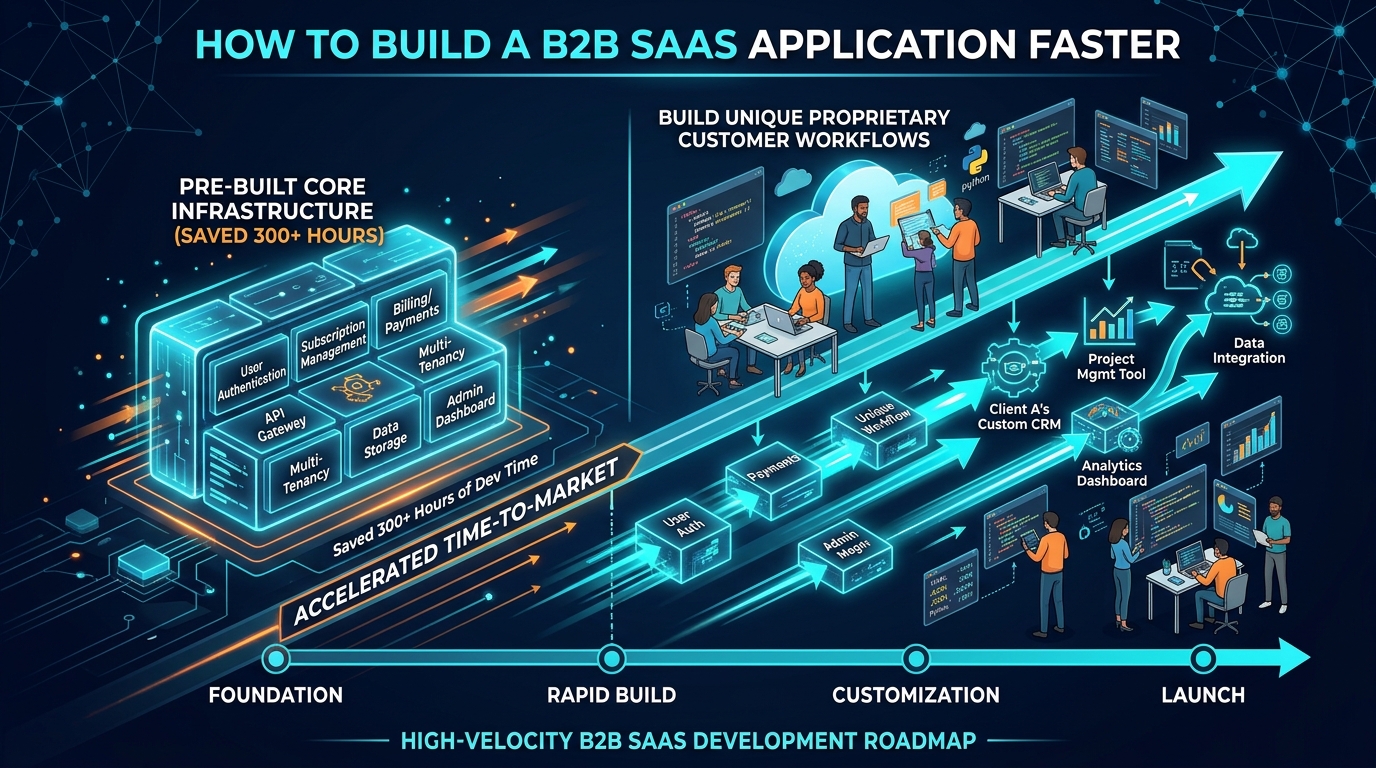
Building a B2B SaaS application requires balancing customer-facing features with the infrastructure that makes those features usable. Founders often underestimate the time needed for accounts, organizations, permissions, subscriptions, and operational setup.
The solution is not simply to write more code faster. It is to reduce avoidable engineering work.
Step 1: Define the Core Business Workflow
Identify the single workflow that delivers your product's primary value. Write down the actions users must complete, the data involved, and the conditions under which access should be allowed.
This prevents the team from spending weeks building generic functionality without validating the product's purpose.
Step 2: Reuse Common Infrastructure
Evaluate existing libraries, starter kits, and reusable modules for authentication, database access, email delivery, and billing.
Reuse is most valuable when the implementation is understandable, maintainable, and appropriate for your security requirements.
Step 3: Design the Tenant and Permission Model Early
If your product serves multiple organizations, define the relationships between users, workspaces, memberships, and resources before adding many features.
Retrofitting tenant isolation into an application can be significantly more difficult than designing it into the initial architecture.
Step 4: Connect the Critical Workflows
Test the complete journey: registration, onboarding, creating a workspace, inviting a teammate, purchasing a subscription, and accessing paid features.
A collection of individually working screens can still fail as an integrated application.
Step 5: Use AI With Review and Testing
AI coding tools can accelerate implementation, documentation, and test creation. Give them clear requirements, narrow change scopes, and explicit acceptance criteria.
Review the generated changes, run checks, and retest affected workflows.
Step 6: Prepare a Repeatable Launch Process
Validate configuration, database migrations, external service credentials, permissions, error handling, and deployment instructions.
Do not confuse a running development server with a verified launch.
Conclusion
The fastest sustainable approach is to reuse suitable infrastructure while concentrating engineering effort on what differentiates your product.
Agentium Start provides a structured B2B SaaS foundation that you can adapt using your preferred coding tools. Explore the source kit to see which foundational tasks it can help you avoid rebuilding.