
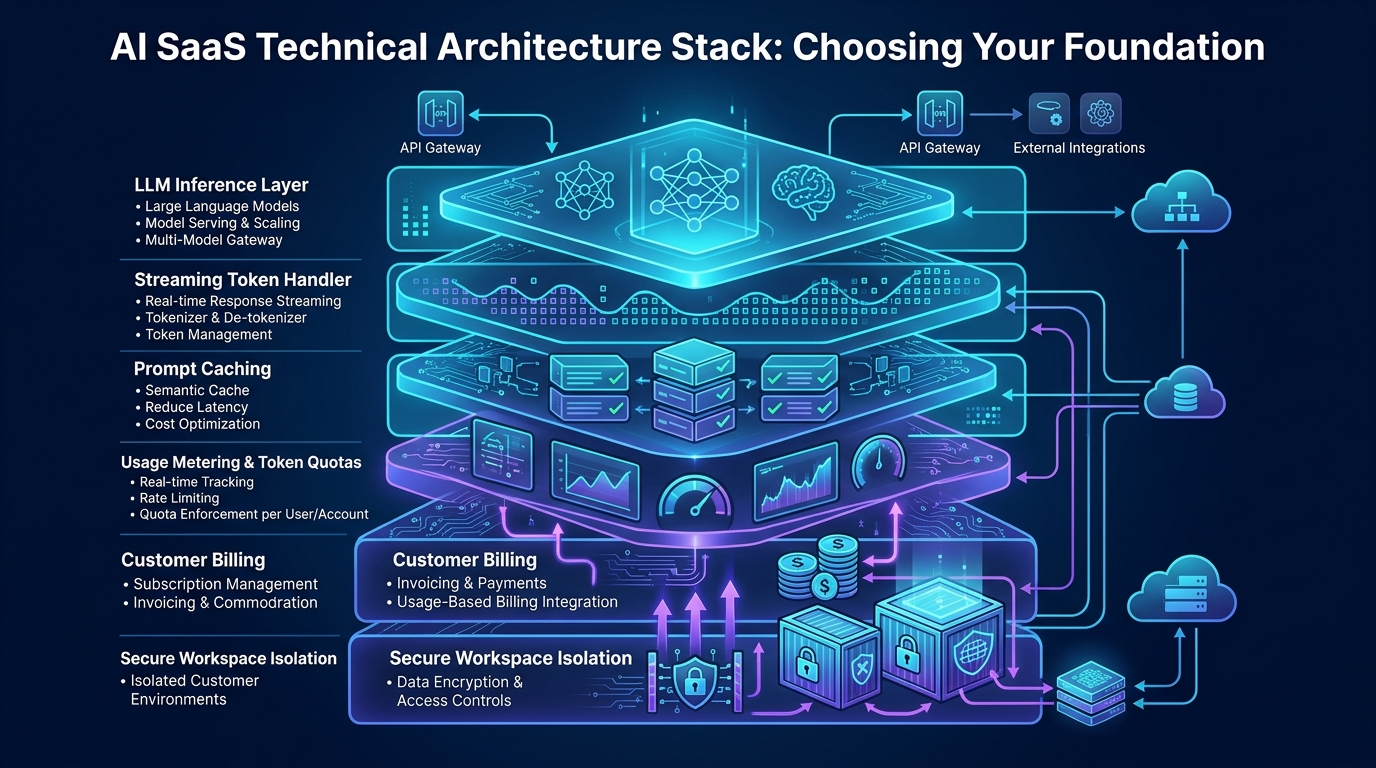
Choose an AI SaaS foundation by evaluating the application around the model as carefully as the model integration itself. Customers need a dependable place to sign in, access their organization's data, complete work, review results, and understand what they are paying for. Your model workflow should fit into that application with explicit permissions, budgets, and failure handling.
Start from the paid outcome. A product that drafts support replies requires different controls from one that extracts purchase-order fields or runs an autonomous research process.
Describe the AI task precisely
Write down the input, desired output, allowed information, and consequences of a bad result. For a hypothetical customer-support drafting tool, the input might be a customer question and approved account context. The output is a suggested reply for a human support agent to review.
Decide what the model is permitted to do. Generating a draft, selecting a category, updating a customer record, and sending an email represent different levels of authority. Treat each as a separate product decision.
Anthropic's guide to building effective agents distinguishes predefined workflows from systems where a model directs its own process. Use that distinction when selecting your starting architecture. A narrow drafting task may benefit from a controlled sequence without needing a broadly autonomous agent.
Separate the application from model execution
Organize the product into understandable responsibilities. The application establishes identity, workspace membership, permissions, subscription access, and business records. A workflow service assembles the allowed context, applies budgets, calls a provider, validates results, and records the outcome.
Provider-specific code should handle the details of making a request and interpreting the response. It should not independently decide which customer owns a record or whether a user can access a premium feature.
This division allows the same application rules to serve an AI action and a conventional interface. For example, a suggested ticket update should pass through the existing ticket-update authorization path. The model's recommendation does not replace the server's decision about whether the action is allowed.
Evaluate the customer foundation
Inspect how a candidate handles organizations, members, roles, invitations, and billing ownership. The support drafting tool may serve many businesses, each with its own staff, knowledge documents, and subscription. Those boundaries must remain consistent across the interface and the model context.
Agentium Start's published scope includes implemented workspace, role, billing, email, and application-shell capabilities. Its AI development recipes and landing-page designs should be evaluated as those deliverables, with the customer-facing AI workflow scoped separately.
Ask which requirements your application adds. You may need request-level usage accounting, evaluation datasets, retrieval permissions, or a review queue. Do not infer those implementations from the presence of an AI-themed template or a generic task screen.
Keep customer data boundaries inside the workflow
Before assembling a prompt, establish the actor's authorized workspace and the resources they may use. Retrieve documents using those boundaries. Avoid fetching a broad collection and relying on the model to ignore material from other customers.
Apply the same ownership rules to cached outputs, embeddings, files, job records, and conversation history where those components exist. A model request may be short-lived, while the artifacts it creates remain in your product for much longer.
For the support example, a shared employee account might belong to two customer workspaces. The drafting workflow should obtain the active, authorized context for that request, rather than using whichever organization happened to be visited most recently. Treat background work with the same care so a later job does not inherit an unrelated browser selection.
Design the result lifecycle
Represent an AI operation with useful states such as queued, running, ready for review, failed, and cancelled where those states match your product. Give it an identifier the user interface and operators can reference.
Define output validation at multiple levels. Check that required fields exist, referenced records belong to the right customer, and the result satisfies the business constraints. For a support reply, missing account information should lead to an honest draft or a request for review, rather than fabricated details.
If the task changes external state, separate the proposed action from its authorized execution. A human review step can be appropriate when the user should inspect the result first. Keep the exact reviewed version attached to the action so later edits do not silently change what was approved.
Budget and evaluate before expanding
Decide how usage maps to your plans and how expensive operations are limited. Record input and output usage when available, provider attempts, workflow duration, and final status. Keep customer-facing allowances understandable even if internal cost accounting uses more detailed units.
Build representative examples for evaluation before repeatedly changing prompts. For the drafting tool, include incomplete context, contradictory notes, an unsupported promise request, and a question outside the account's knowledge. Decide what a satisfactory response looks like for each.
Measure both quality and operating cost. A model change that produces better drafts may still need a different timeout, usage allowance, or review process. Avoid selecting a foundation based solely on how quickly a single attractive demo can be produced.
Choose the foundation your team can maintain
Trace one AI operation from customer input to stored result, including permission checks, context assembly, provider errors, validation, and usage recording. Identify who would diagnose each failure.
Then compare the candidate's existing capabilities with that path and estimate the missing work. The foundation should make the conventional application easier to own while leaving clear places for your AI-specific decisions.
Explore Agentium Start if you want an editable B2B source foundation for that approach. Build the model workflow around a precise customer outcome and require the same clarity from the application that surrounds it.
Authority References & Sources: