
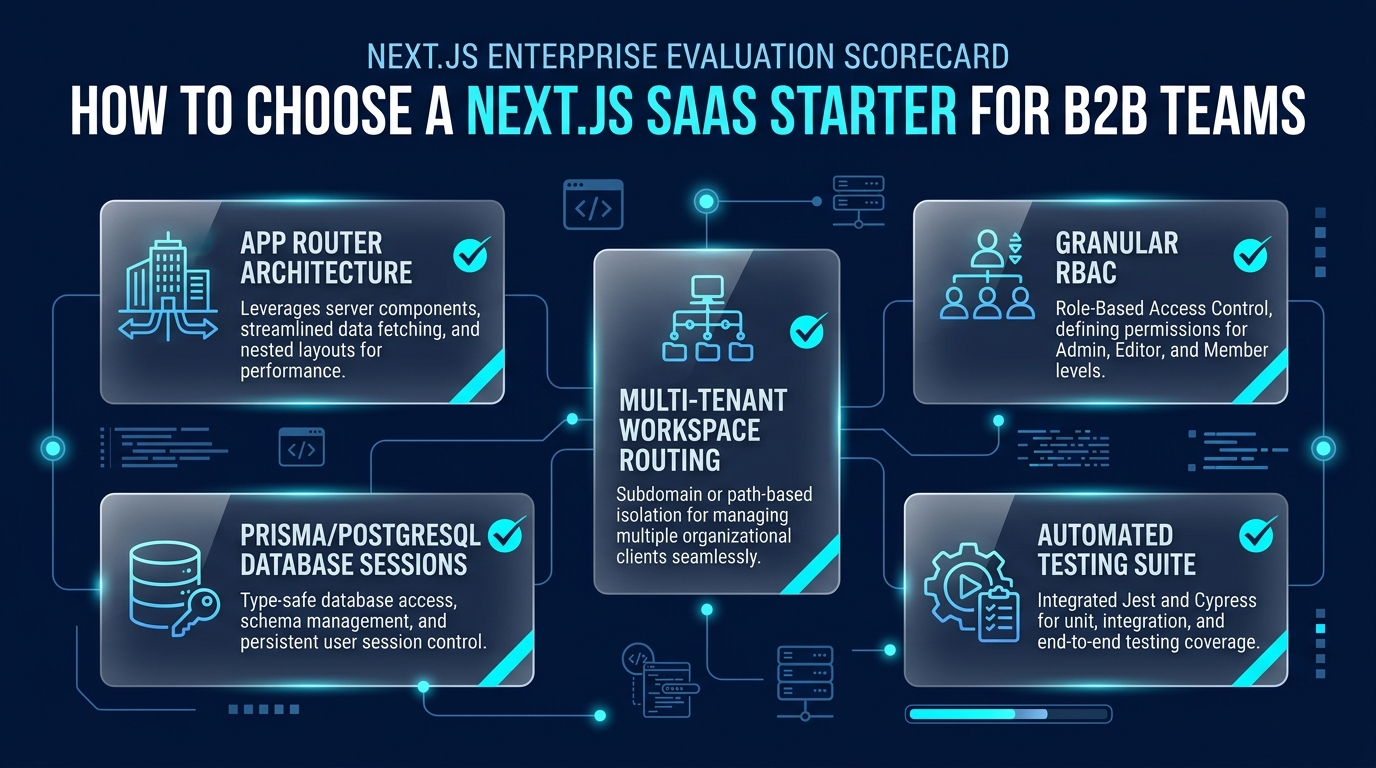
Choose a Next.js SaaS starter by tracing the workflow your first paying customer will use. Framework familiarity matters, but the strongest fit is a codebase whose customer model, billing behavior, and extension conventions match your product. An impressive homepage cannot tell you whether an approval, export, or invitation will remain correct after you customize the application.
Start with a one-page requirement brief. Name the buyer, primary user, billable customer, core business object, and first paid outcome. Use that brief to evaluate a small shortlist consistently.
Define the shape of your customer
A personal productivity app and a team application can both use Next.js while needing different foundations. For a B2B product, establish whether subscriptions belong to users or workspaces. Decide whether one user can join multiple customers, whether customers need different member roles, and who can administer billing.
These decisions influence far more than settings screens. They affect uniqueness rules, ownership of data, invitation acceptance, cancellation, and account deletion. A starter that assumes every record belongs to one individual may require significant adaptation for shared team workflows.
Write a few access examples in plain language. An editor may change a draft request but cannot approve it. A finance user may open billing without editing requests. A removed member must lose access even if an old browser tab remains open. Ask how the candidate represents each example.
Check framework compatibility where it matters
Record the delivered framework and runtime versions, the dependency lockfile, and the documented setup prerequisites. You need to know what you will actually run, rather than simply whether the seller advertises a recent framework.
Inspect the division between server work and interactive browser components. Check where database access, secret-bearing provider calls, input validation, and business rules live. Readable boundaries help your team make future changes without accidentally pushing private behavior into the client.
The Next.js production checklist covers production concerns including rendering, caching, security, and performance. Use the relevant sections as prompts for your own application review. A framework supplies mechanisms; your particular routes and data still require deliberate configuration.
Evaluate the integration paths you will keep
Identify the identity, billing, database, email, storage, and job providers in the reference implementation. Decide which ones you intend to use and which must change. Every replacement expands the adaptation work, especially where provider events influence customer access.
For example, Agentium Start's published scope names workspaces and roles, Paddle checkout and webhooks, email components, and Inngest jobs. A team planning to retain those paths can assess the existing implementation directly. A team with a mandatory alternative billing provider should evaluate the replacement as a separate engineering task.
Look beyond whether an SDK appears in the dependency list. Ask where failures are recorded, how retries are bounded, and how application state is reconciled. A provider integration is valuable when it has an understandable lifecycle.
Run a small extension exercise
Consider a hypothetical purchase approval app for small architecture firms. Its essential object is a purchase request containing a supplier, amount, explanation, and approval status. A requester submits it; a manager approves or rejects it.
During evaluation, follow how you would add that object to the schema, create its form, enforce workspace ownership, and introduce a permission for approving it. Then consider the transition from submitted to approved. It should check the actor's authority and the current state together, so two browser tabs do not produce confusing results.
You do not need to build the entire product to judge the path. A narrow proof can reveal whether the starter offers a consistent pattern or requires scattered edits. Keep notes on the files touched and the assumptions you had to understand. That becomes a useful estimate of future development friction.
Match deployment to your operating capacity
Determine where the app, database, background processing, and uploaded files will run. Check whether preview and production environments can use separate credentials and whether database migrations have a documented release path.
If you plan to operate a server yourself, understand the surrounding infrastructure. The Next.js self-hosting guide recommends a reverse proxy in front of the application server. That is one example of operational work beyond having a runnable repository.
A managed application host can simplify some tasks, but you still need to own configuration, service permissions, monitoring, and recovery. Prefer the hosting approach your team can support when a customer reports a problem. Avoid selecting infrastructure solely because it looks inexpensive before usage and operational effort are considered.
Score evidence and write the decision
Use a short comparison with rows for customer model, core workflow extension, billing lifecycle, local setup, deployment, maintenance, and license fit. Mark each item as demonstrated, documented, requires adaptation, or unknown. Unknowns should produce specific questions.
Do not average away a critical failure. A polished dashboard cannot compensate for an isolation model you cannot verify. Conversely, a missing decorative component may be inexpensive to add and should not dominate the purchase decision.
Finish with a written recommendation explaining why the selected foundation fits, which provider paths you will retain, and what must be completed before launch. Include the person responsible for each material gap.
Review the Agentium Start documentation alongside your evaluation brief if you are considering its source kit. The right Next.js SaaS starter is the one your team can extend, operate, and explain with confidence.
Authority References & Sources: