
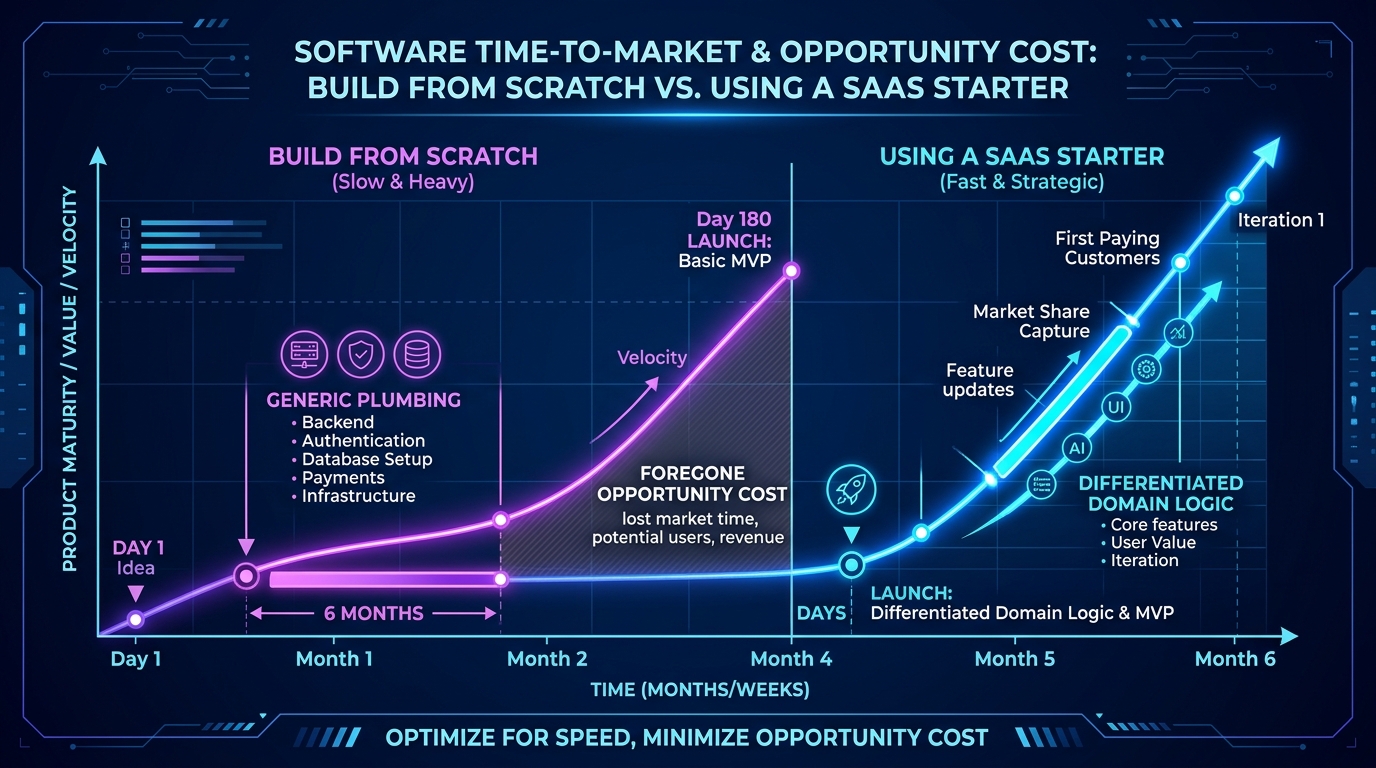
Use a SaaS boilerplate when its existing conventions match the foundation your product needs and you can verify the behavior you will depend on. Build from scratch when your requirements differ enough that adapting a kit would introduce more complexity than it removes. Both paths require product-specific engineering, testing, and ongoing operations.
The useful comparison measures equivalent outcomes. Comparing a polished starter demo with an empty repository leaves out your application on one side and all the integration work on the other.
Compare the same finished foundation
Begin with a shared definition of done. For a team product, this might include sign-in, workspace creation, invitations, server-side permissions, subscriptions, transactional email, monitoring, and a repeatable deployment process. Add the failure paths that matter to those workflows.
Then describe the business feature separately. If you are building a maintenance scheduler, equipment records, inspection rules, and overdue service handling remain product work regardless of how authentication began.
This separation prevents two distortions. The scratch estimate should not assume every common component takes almost no integration work. The boilerplate estimate should not assume all visible screens already satisfy your domain. Both estimates should include learning, verification, and recovery behavior.
Understand the work a boilerplate can remove
A well-matched kit can provide settled conventions, connected provider paths, and examples of how the application expects new features to behave. Reusing these decisions can reduce repeated design and integration work.
The actual value depends on what you keep. Retaining the reference customer model and billing provider is different from replacing authentication, changing the database, and restructuring tenancy immediately. The more fundamental choices you replace, the less of the original integration remains relevant.
Read the published scope carefully. Agentium Start positions its offering as editable B2B application source running on your infrastructure. Its capability catalog distinguishes implemented code from partial and example areas. Use those boundaries when estimating adaptation rather than treating every named capability as finished for your application.
Recognize when scratch development is reasonable
Building your own foundation may be justified by unusual tenancy requirements, an established internal platform, required deployment constraints, or a team with maintained components it already understands. Existing organizational conventions can be more valuable than adopting a new external structure.
The decision should rest on concrete differences. “We want flexibility” is too broad because editable source also offers flexibility. A stronger argument is that customers require a dedicated deployment and data model that conflicts with the candidate kit's assumptions.
Scratch development also gives you responsibility for documenting choices that a starter might otherwise supply. Record how modules call one another, where authorization lives, how configuration is validated, and how release changes reach the database. Without that work, starting clean can quickly become an undocumented collection of individual decisions.
Work through an illustrative effort comparison
Imagine a hypothetical solo founder building a document renewal tracker. The founder estimates 70 hours to assemble and verify the common foundation from scratch. The same founder estimates 28 hours to inspect, configure, adapt, and verify a suitable kit. These are invented planning inputs, not observed results.
Suppose the founder values available development time at an illustrative $40 per hour. The modeled foundation effort is $2,800 for scratch development and $1,120 plus the kit's license price for reuse. Product-specific development and recurring infrastructure costs must be added to both paths.
Now change an assumption. If replacing the kit's customer model adds 45 hours, the reuse path becomes 73 hours before the license price. The apparent advantage disappears in this example. That is why a short extension exercise and a written gap list can matter more than the purchase price.
Keep a range for uncertain tasks. An estimate with explicit uncertainty is more useful than a precise total built on optimistic guesses.
Include maintenance and upgrade responsibility
Owning source does not automatically provide a painless upgrade path. Your application will diverge as you add business logic and change integrations. Determine how you will identify relevant upstream fixes, review changes, and bring them into your version.
Scratch development has equivalent responsibilities for the dependencies and integrations you selected. Its lack of a purchased kit does not eliminate framework upgrades, provider changes, security fixes, or documentation work.
Database changes require particular care on both paths. Prisma's migration documentation describes inspecting and applying planned database changes. For your project, preserve migration history and review the implications for existing customer records. Use the instructions that match the version actually installed in your repository.
Set aside operating capacity for these tasks before spending every available hour on features. Maintenance becomes harder when the only person who understands the foundation is constantly committed elsewhere.
Make a reversible decision where possible
Reduce uncertainty with a bounded investigation. For the renewal tracker, prove workspace creation, one customer-owned record, a due-date update, and a permission denial. Trace the expected subscription decision even if you have not yet configured a live payment account.
Record what felt straightforward, which changes crossed many modules, and what evidence was missing. Use that result to revise both effort estimates. If the fit is poor, you can reject the kit before your full product depends on it.
If the fit is strong, retain its conventions intentionally and place new domain behavior in understandable modules. Avoid immediately redesigning the parts you selected the kit to reuse.
Choose the path that leaves your team with a foundation it can maintain and enough capacity to build the paid workflow. A good decision is supported by clear assumptions, a small practical proof, and an honest account of the work still ahead.
Compare Agentium Start with that shared definition of done if a reusable B2B source kit fits your shortlist.
Authority References & Sources: