
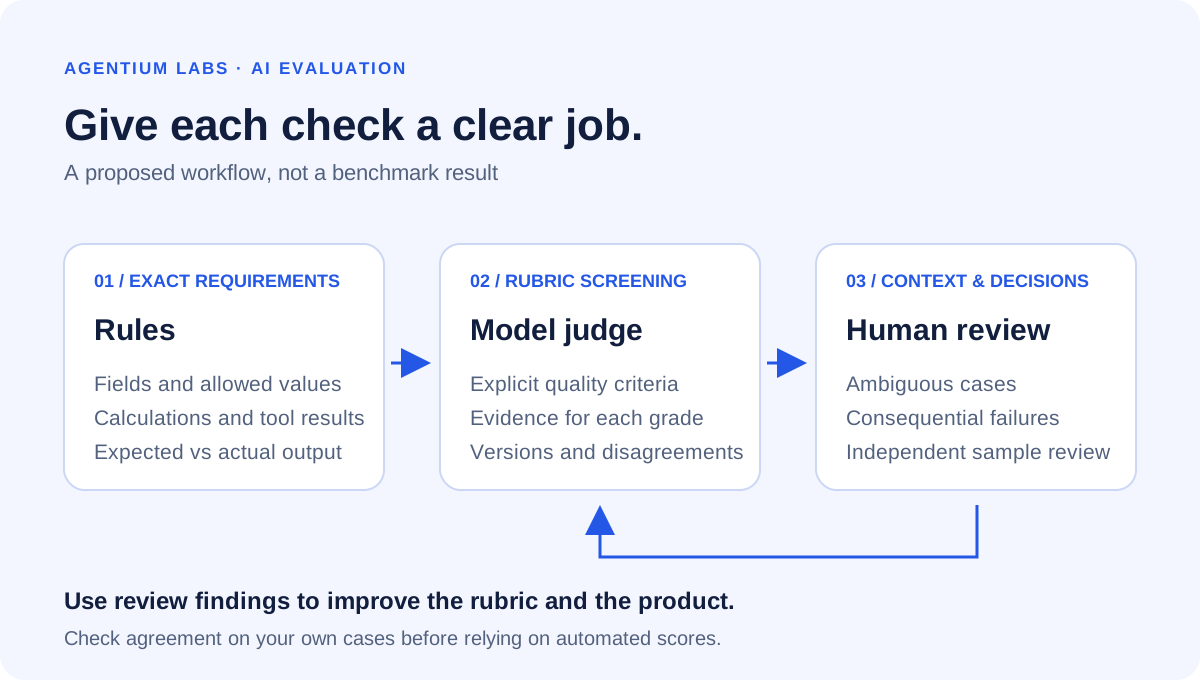
Use a model judge to help screen many AI responses against a defined rubric, human review to resolve ambiguous or consequential cases, and deterministic rules for requirements that can be checked exactly. A useful evaluation workflow combines these methods and tests whether its automated judgments agree with the decisions your team actually wants to make.
“LLM-as-a-judge” means asking a language model to assess another response. The judge might choose between two answers, classify a failure, or return a score with supporting evidence. Human review means a person examines the case using relevant context and an agreed set of criteria. Neither label, by itself, tells you whether the judgment is dependable.
This guide proposes a practical workflow for a software team. It does not report an Agentium benchmark or rank current judge models. For the wider release process, see our AI feature evaluation guide.
What should each kind of check do?
Begin with the decision you need to make. “Did quality improve?” is too broad if the release changes answer correctness, tone, and access to customer information at the same time. Write separate criteria so a pleasant answer cannot hide a factual failure.
| Check | Useful starting point | Evidence to retain | Main limitation |
|---|---|---|---|
| Deterministic rule | Required fields, permitted values, exact calculations, or a known tool result | Input, rule version, expected result, actual result | The rule only checks what it explicitly expresses |
| Model judge | Screening responses against a clear rubric, grouping likely failures, or comparing candidate answers | Rubric, judge version, inputs, judgment, cited response excerpt | Its interpretation and preferences can differ from your intended criteria |
| Human reviewer | Unclear instructions, domain-specific distinctions, disputed grades, or consequential failures | The displayed case, independent rating, reason, and resolution | Review requires time, context, and a process for disagreements |
These are proposed responsibilities, not exclusive capabilities. A rule may require human interpretation when the underlying business policy is unclear. A human reviewer may also overlook an incorrect calculation that a simple check would catch.
Define a rubric before choosing the judge
A rubric is a written description of what counts as a good or bad result. Write it so two reviewers can apply it to the same case and explain their decisions.
For a support assistant explaining a subscription policy, separate four questions:
- Did the answer use the policy that applied to this customer and date?
- Did it distinguish confirmed information from missing information?
- Did it avoid claiming that a cancellation or refund happened without a confirming tool result?
- Did it explain the next available action clearly?
Give each criterion an allowed outcome, such as pass, fail, or insufficient evidence. Include examples of borderline cases. “Helpful and accurate” sounds reasonable but gives a judge little guidance about how to resolve competing concerns.
Choose which failures prevent release before looking at an aggregate score. For this illustrative support workflow, falsely claiming a completed account action would warrant separate investigation even if most answers sounded clear. Your actual release policy should reflect the product and the consequences of its mistakes.
Create an independently reviewed reference set
Before delegating routine assessment, collect cases that represent the decisions you care about. Include ordinary successes, known failures, missing context, and cases where the answer looks convincing but the supporting evidence is wrong.
Have reviewers assess a selection without seeing the model judge’s grade first. Otherwise, the review process can become an explanation of an existing score rather than an independent assessment. Preserve the original rating when a later discussion changes the final decision.
Record why people disagree. One reviewer might be applying an older policy; another might lack the tool result needed to assess the case. Resolving those differences can improve the instructions or the evaluation data before you change any model.
There is no universal reference-set size that proves a judge is suitable. Start with a manageable set that exposes important distinctions, then expand it as failures and product use reveal gaps. A small convenience sample should not become a claim about every future customer interaction.
Check judge behavior on your own cases
Research gives reasons to test the evaluator itself. Zheng and colleagues’ MT-Bench and Chatbot Arena paper examines limitations including position and verbosity preferences in model judging. Those results concern the models, tasks, and procedures studied; they do not establish one accuracy figure for every evaluation workflow.
For a pairwise comparison, swap the order of the answers and inspect cases where the winner changes. Also compare a concise correct answer with a longer answer that adds little useful information. These checks can expose preferences that conflict with your rubric.
Position effects deserve more than a one-off spot check. Shi and colleagues’ systematic study of position bias finds variation across judges and tasks. Treat an order-swap check as a diagnostic, rather than a guarantee that all bias has been removed.
Track false passes separately from false failures. A judge that approves an unsupported account-action claim creates a different operational problem from one that flags an acceptable wording choice. An overall agreement percentage can hide that distinction, particularly when most test cases are easy successes.
Combine the checks in a repeatable workflow
For a first implementation, use the following sequence:
- Run exact checks for requirements you can express reliably.
- Give the model judge the response, the relevant reference material, and a versioned rubric.
- Retain the judgment alongside the specific evidence it refers to.
- Send disputed cases, important failures, and a sample of apparent successes for independent human review.
- Resolve disagreements and decide whether the problem belongs to the product, the rubric, the reference material, or the judge.
Reviewing apparent successes matters because a queue containing only model-flagged failures cannot reveal all the cases the model approved incorrectly. Choose the sample according to the consequence of a missed failure and the volume your team can review.
Keep configuration changes visible. A new product model, judge model, prompt, or policy reference changes what the evaluation result means. Recheck the reference cases when these change instead of assuming yesterday’s agreement still applies.
Compare the actual cost of the workflow
A model judgment has more costs than an API call. Include preparing reference material, retrying failed requests, investigating unexplained scores, and reviewing disagreements. Human review also includes coordination and resolving inconsistent interpretations.
For planning, track these components separately:
- Automated assessment cost for each evaluated case.
- Human review time for the selected cases.
- Time spent resolving disagreements and maintaining the rubric.
- The operational consequence of failures the process misses.
Use observed costs from a trial of your own workflow. This article supplies no current vendor prices or assumed time savings. A cheap judge that creates an unmanageable review queue may be a poor choice for your team; a more expensive review process may be appropriate for decisions with greater consequences.
What should remain with human reviewers?
Assign someone responsibility for the release decision and the exceptions to it. A model-generated explanation does not decide whether a particular failure is acceptable for the business or its users.
Keep humans involved where the evidence is incomplete, the criteria remain disputed, or the consequences require relevant professional or organizational judgment. The NIST AI Risk Management Framework provides a broader risk-management reference; it is not a certification that a particular judge or scoring tool is safe.
Start with one product workflow, a clear rubric, and independently reviewed examples. Automate the parts you can verify, inspect disagreements, and retain enough evidence to explain the eventual decision. Our guide to inspecting AI evaluation scores provides a practical next step.