
Disclosure: this comparison is published by Agentium Labs, the maker of Agentium Start. We have reviewed public product descriptions, not independently audited both repositories. Check current documentation and purchase terms before deciding.
Start with your team’s working style
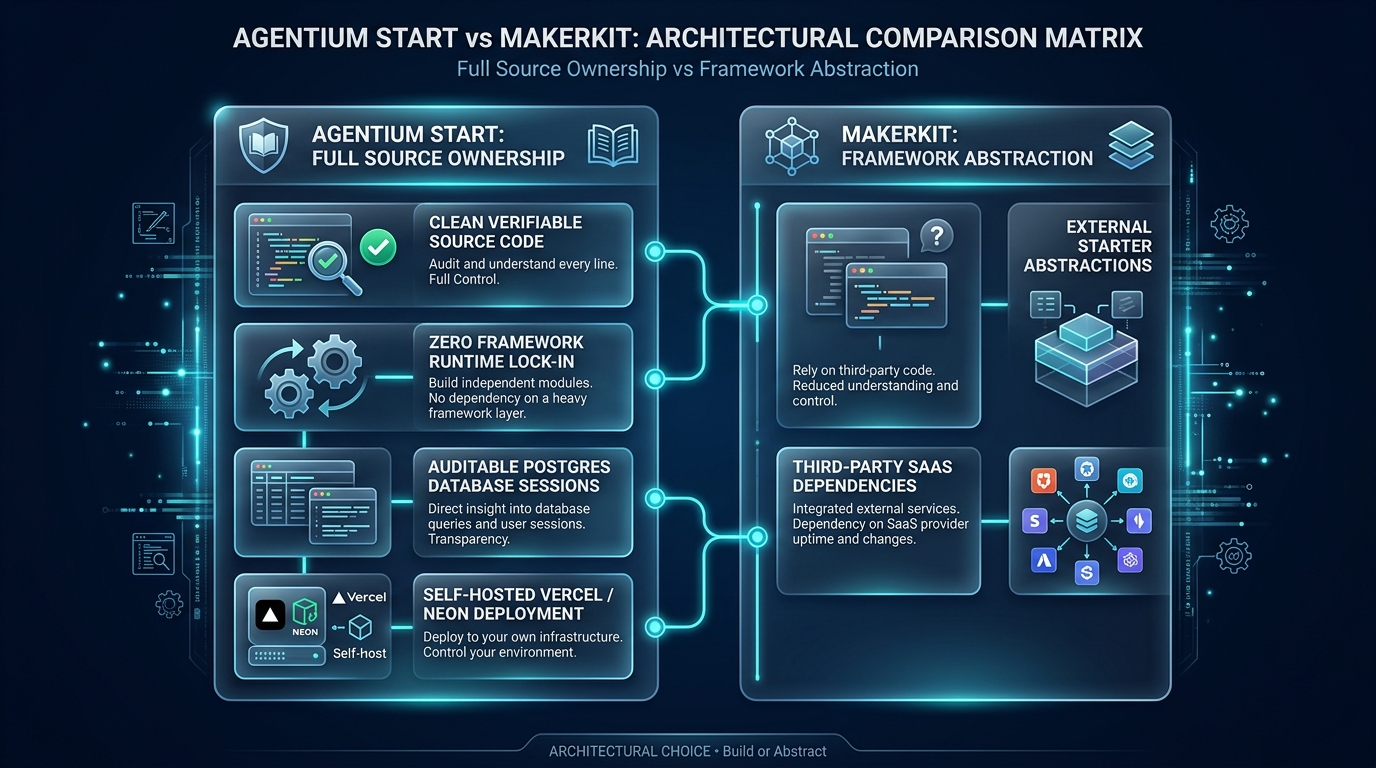
Makerkit publicly presents a Next.js SaaS foundation with team-oriented application features and developer tooling, including AI-related workflows. Agentium Start is our commercial B2B source kit, focused on an integrated starting application, reviewed extension workflows and deployment on the buyer’s accounts.
“Supports teams” and “works with AI” are not enough to choose between them. Evaluate how the actual development experience fits your team’s habits and required application.
Ask where decisions live
Pick one feature request your team expects to build. Locate the permission policy, the workspace context, validation, business operation and persistence layer in the relevant documentation or source access available to you.
Can a new developer explain those boundaries? Does the example follow the same conventions as the rest of the application? A foundation saves effort when it makes changes predictable, not when it creates another set of exceptions to learn.
Evaluate AI tooling by an operation
A rules file, skill or MCP interface can be useful. The operational question is what a proposed change can do, what a human must approve and how the result is checked.
Use the same feature request with the coding tools you intend to use. Ask for a change plan and inspect the actual diff. Check what happens when the proposed change would bypass a permission or alter existing data. Neither product should be assumed safe merely because an AI workflow has a polished name.
Check the team and client license
Review who may access the reusable source, whether contractors count as seats, whether client delivery is permitted and what the client receives. Read the current legal terms rather than infer rights from a pricing-card heading.
The Agentium Start pricing page describes its current editions at https://start.agentiumlabs.com/pricing. Use the live terms for your purchase. This article is not a substitute for either vendor’s license.
Include updates in the evaluation
A starter becomes part of your application. Investigate how source updates reach you and how you preserve your custom work. Check migration guidance, release notes and the support process for reproducible issues.
Do not compare only the length of the support window. Ask what that support covers and what implementation work remains yours. An unlimited-sounding promise is not necessarily more useful than clear boundaries.
How to choose
Makerkit may be the better choice when its documented architecture, tooling, examples and current commercial model match your team. Agentium Start is worth evaluating when its B2B reference flow, source structure and reviewed-change approach match the task you want to deliver.
A team with an established internal starter may need neither. A buyer who needs a different stack should not force a kit to fit simply because its demo is attractive.
Run a small evaluation: one new workspace feature, one prohibited action, one relevant regression check and one documented deployment. Record where each path needs manual correction or vendor help. That gives you a decision rooted in your work rather than our marketing.
Official sources: https://makerkit.dev/ and https://start.agentiumlabs.com/. Add the actual reviewed-on date when publishing; public offers change. No universal winner or measured time-saving claim is made.