
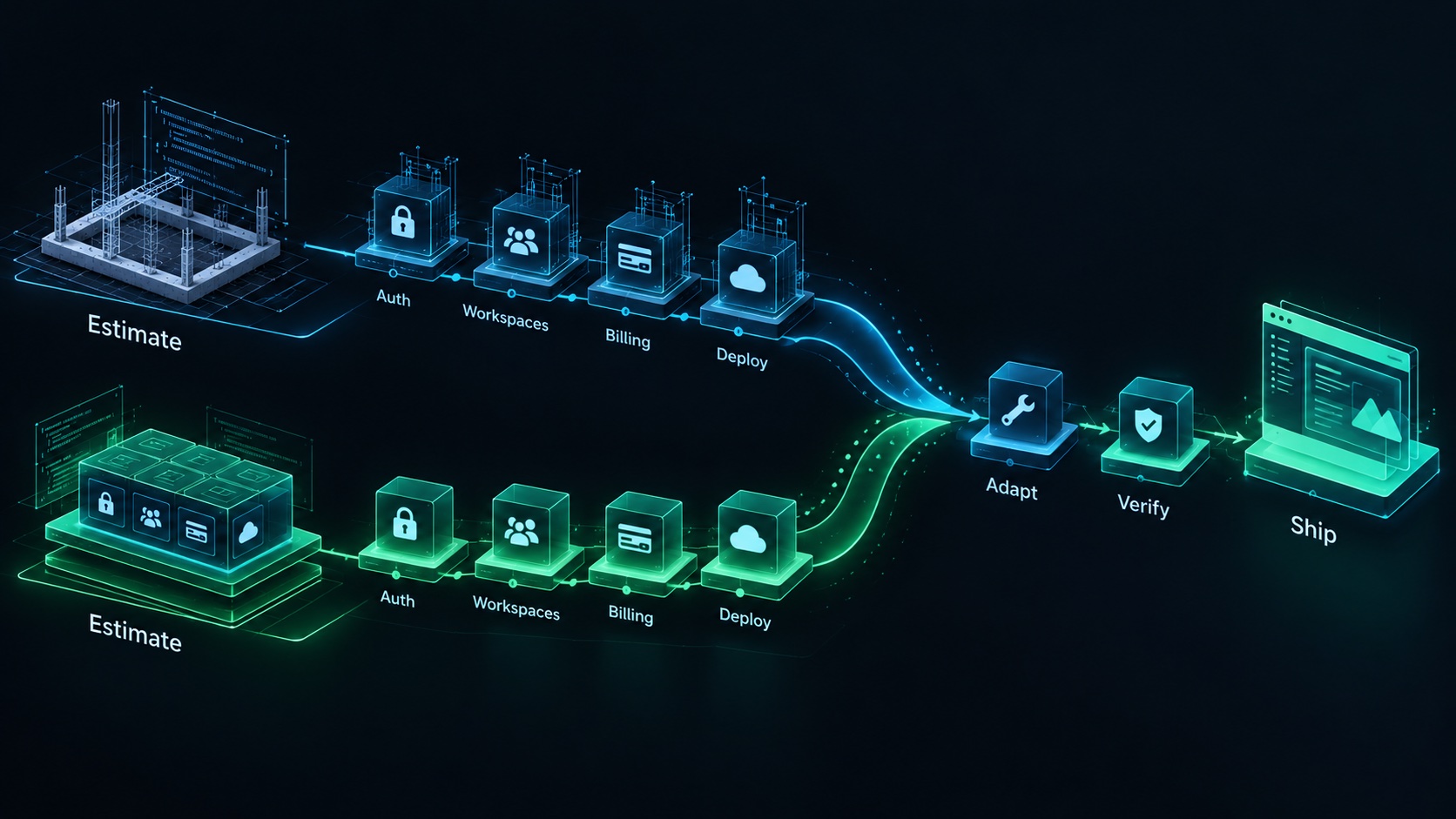
A SaaS boilerplate can reduce the amount of foundational code a developer must write, but the actual time saved depends on the application, the boilerplate's quality, and the work required to adapt it.
There is no reliable universal number that applies to every project.
Identify the Work You Would Otherwise Build
List the components required by your product: authentication, workspaces, roles, database integration, billing, email notifications, configuration, and deployment.
Estimate the work required to implement and test each component independently.
Subtract Adaptation Work
A boilerplate still needs configuration, review, customization, and integration with your business-specific features.
A starter kit built around an unsuitable architecture may require extensive rework. A well-matched foundation can reduce duplication more effectively.
Include Verification Time
Do not measure only the time needed to get the application running locally.
Include regression tests, access-control checks, billing webhook validation, environment configuration, and deployment preparation.
Run a Small Pilot
Choose one representative workflow and compare the time required to adapt an existing foundation with the time required to build the same capability from scratch.
Use the same acceptance criteria for both approaches and document assumptions.
Conclusion
The value of a boilerplate is the amount of suitable, verified groundwork it lets you reuse—not a promised number of saved hours.
Agentium Start includes an illustrative time-saving calculator on its homepage. Its example is explicitly presented as an illustration, not a measured customer benchmark. Use your own estimates when assessing the Agentium Start foundation.