
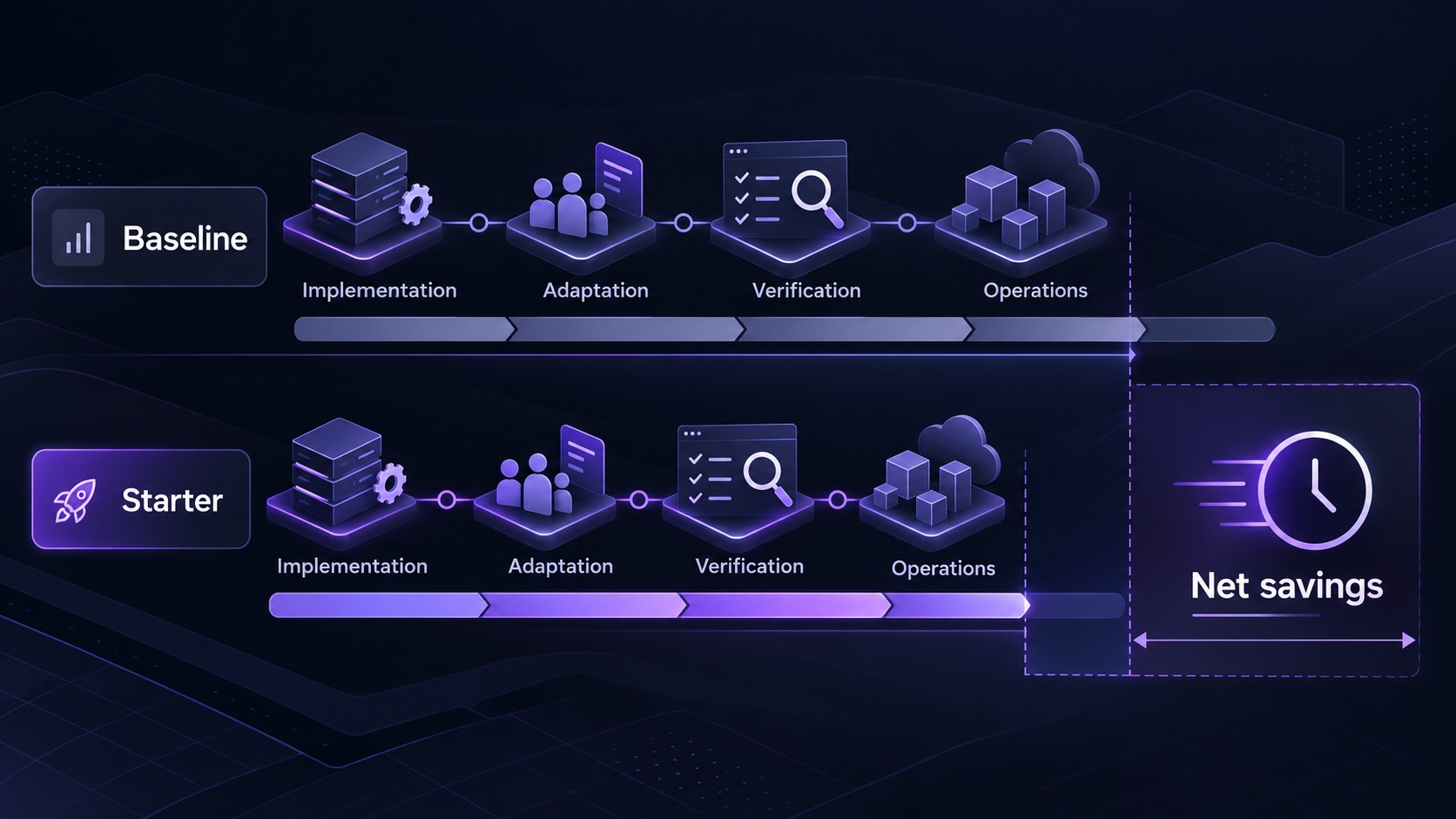
The honest answer depends on the application, the developer and the starting point. A SaaS starter can save integration work, but it can also require learning and adaptation. A useful comparison measures both.
This article explains a proposed measurement method. It does not report a controlled experiment or claim that Agentium Start saves every buyer a particular number of hours.
Define a complete task
Use a task that reflects the application you intend to operate. For example: set up the supported environment, sign in, create a workspace, add a record, apply a role restriction and deploy the result.
Include one meaningful custom change. A ready-made demo can be quick to run while the first adaptation reveals most of the effort.
Agree the acceptance criteria before starting. “Looks finished” is not the same as correct behavior under the conditions that matter to the buyer.
Keep the tools and conditions comparable
Use the same coding assistant and a developer with comparable familiarity where practical. Record prior experience rather than pretending all participants begin with identical knowledge.
Avoid giving one path working credentials, prepared data and an expert guide while the other starts from nothing. If the test is assisted, say so. If it is a founder demonstration rather than an independent evaluation, say that too.
Count the whole effort
Track active setup, reading, configuration, debugging, change review, test execution and deployment verification. Record waiting time separately, especially when it comes from external approvals or provider delays.
For the source-kit path, include removing unwanted functionality, reconciling conventions and fixing any kit problems. For the baseline, include selecting dependencies and integrating the chosen starter or generated code.
The goal is not to make one path look slow. It is to understand the work a real buyer would do.
Use a simple calculation
Net time saved equals baseline effort minus source-kit effort, using the same definition of effort on both sides.
For an illustration only, suppose the baseline takes 40 hours and learning, configuring and adapting the kit takes 16. The difference is 24 hours. Those are example inputs, not measured results. A buyer whose kit effort is higher than the baseline has no time saving in that scenario.
To estimate economic value, multiply a defensible hour estimate by the buyer’s own value of time and compare it with the purchase and extra operating costs. Do not treat that calculation as a guarantee of revenue or profit.
Publish the limits with the result
A credible report identifies the task, release, environment, participants, assistance, sample size and unresolved issues. Distinguish a single run from repeated observations. A small pilot can reveal a problem without proving how every future buyer will perform.
Do not compare a raw generation time with a fully tested deployment time and call the result a product speed comparison. They are different tasks.
What Agentium Start should demonstrate
Our product is intended to reduce repeated groundwork around a B2B SaaS application. The strongest evidence would be an outsider completing the supported setup, a real workflow and a custom extension with less total effort than their normal approach.
Until a particular measured result is published, treat example savings as scenarios. The current offer and any available testing scope are at Agentium Start.
Disclosure: Agentium Labs makes Agentium Start. This is a measurement framework and an illustrative calculation, not an independent benchmark or a promise that purchasing a kit produces business success.
Measurement Worksheet
-
Task and acceptance criteria: ____
-
Baseline starter/tools/version: ____
-
Agentium Start version/tools: ____
-
Developer prior familiarity: ____
-
Active setup / adaptation / debugging / testing / deployment time: ____
-
External waiting time: ____
-
Assistance provided: ____
-
Accepted result and unresolved issues: ____
-
Permission to publish any participant information: ____