
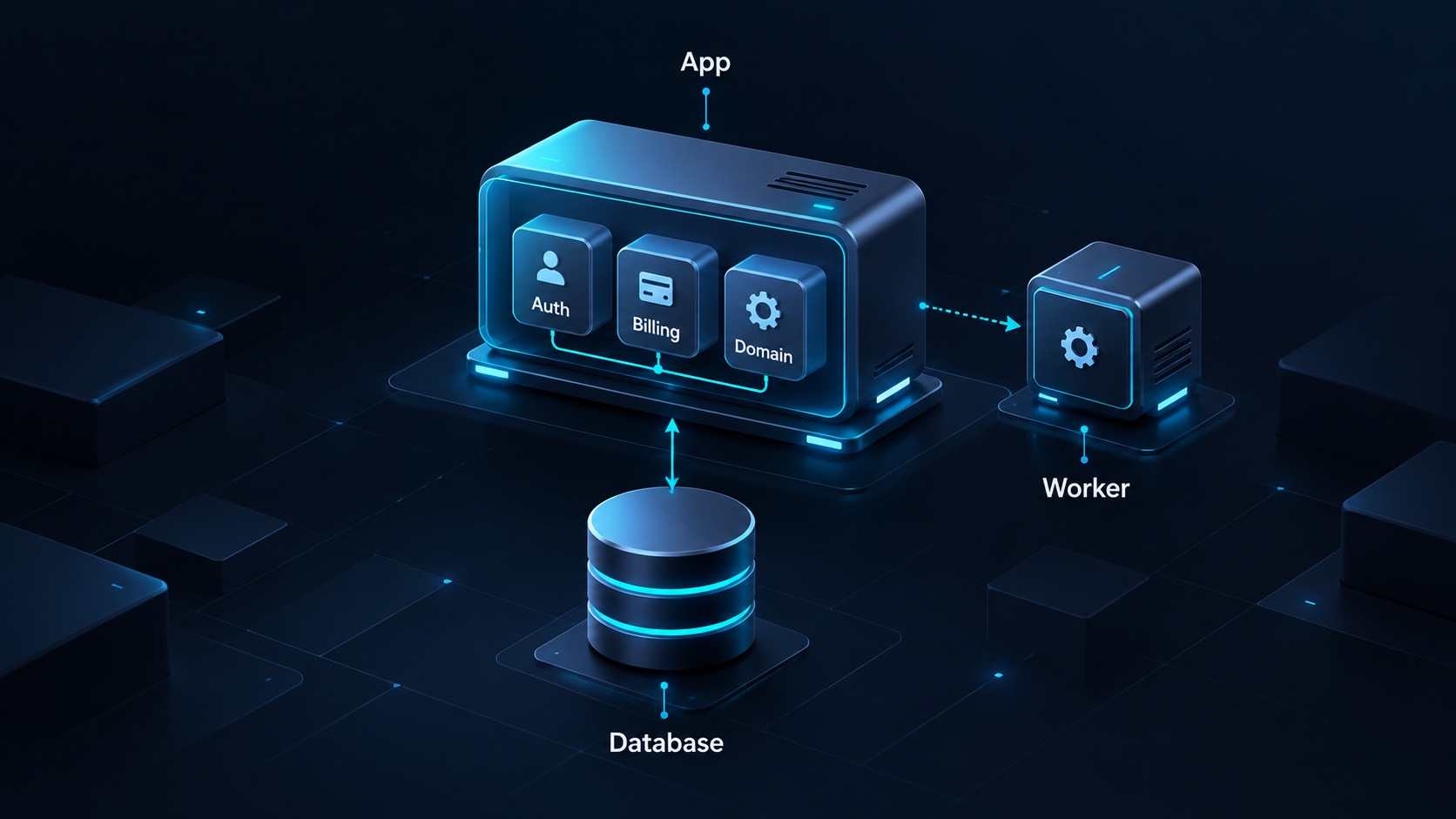
A practical micro SaaS architecture usually starts with a small number of understandable components: the application, its database, essential external providers, and a way to run work that should continue beyond a browser request. Organize these around clear business responsibilities. Add infrastructure when a specific workload or operating problem justifies it.
Small does not mean careless. A narrow product still needs customer isolation, dependable state changes, usable failure records, and a release process its maintainer understands.
Begin with the paid business object
Imagine a hypothetical tool for regional delivery businesses that tracks damaged-package investigations. The paid workflow starts with a reported issue and ends with a documented resolution. The central records might be a customer workspace, delivery reference, issue, attachment, comment, and resolution decision.
Describe the relationships and state changes before selecting extra services. An issue belongs to one workspace. A comment belongs to an issue. A resolution records who made the decision and which evidence they considered.
Keep identifiers and ownership consistent. If files, exports, and job records each use unrelated notions of customer ownership, future access checks become difficult to reason about. A deliberate model lets the small application stay understandable as it gains more functions.
Use modules within one application
A single deployable application can still have clear internal boundaries. Group code around responsibilities such as identity, workspaces, billing, issues, notifications, and provider integrations. Define a small public interface for each module where that improves clarity.
Keep business decisions in places that different entry points can reuse. The rule for closing an investigation should not exist independently in a page action, an API endpoint, and a background task. Each path should reach the same decision logic.
This structure can make a monolithic deployment easier to change without creating separate network services. It also gives you a future extraction boundary if one component eventually needs independent scaling or ownership. You do not need to pay that operational cost before the requirement exists.
Choose a database you can operate
For the delivery example, a relational database is a straightforward option because issues, members, attachments, and decisions have explicit relationships. Model important constraints deliberately, including ownership and allowed uniqueness within a workspace.
Tenant isolation needs a consistent application strategy. Database controls may provide an additional layer where appropriate. PostgreSQL supports row security policies, but its documentation explains that privileged roles and table ownership can bypass those policies. If you adopt them, verify the actual connection role and execution behavior.
Do not assume that choosing a particular database automatically isolates customer data. Inspect how every read and change receives the authorized customer context, including administration, exports, and background work. Test with multiple fictional customers early, while the model is still easy to correct.
Move work off the request path deliberately
Some operations can finish while the user waits, such as saving a short issue description. Others may involve slow providers, large exports, file processing, or scheduled reminders. These are candidates for asynchronous jobs.
The job should have an identifiable record, a clear status, and enough context to authorize its work correctly. Define what happens when it runs twice or fails halfway through. A retry should not send the same resolution email repeatedly or create multiple final reports.
For the delivery tool, generating an investigation bundle could run in the background. The interface can show that the export is being prepared and later provide a protected download. This is a specific reason to use job infrastructure; the existence of a job library alone is not a reason to make every action asynchronous.
Reuse foundational infrastructure selectively
A starter can establish conventions for the common application components. Agentium Start's published features include a Next.js and database foundation, workspaces, roles, email components, durable jobs, and S3-compatible upload support.
Use the parts that fit your workflow and inspect how they connect. The delivery issue model, evidence review, and resolution behavior remain your implementation. If an advertised area is marked partial, include the relevant completion work in your plan.
Avoid replacing the reference architecture just to give the application a more elaborate diagram. Every additional queue, cache, service, or database creates configuration, monitoring, and recovery responsibilities. Its benefit should answer a concrete need in the product you are operating.
Establish a small operating loop
Record errors with request or job identifiers, useful status categories, and enough workspace context to investigate safely. Know how to determine whether a customer's failed action was rejected, partially completed, or waiting on a dependency.
Prepare database backups and understand the restoration process provided by your hosting arrangement. Review configuration changes and database changes as part of releases. Keep a short guide for the tasks only the founder currently understands.
Measure the operations that might eventually justify architectural changes. Examples include repeated database contention on a known query, job queues that miss a product deadline, or a workload whose memory requirements affect the rest of the application. These observations give you an engineering reason to change the system.
Expand in response to a demonstrated constraint
The first response to a slow investigation list might be a better query and index, not a separate search service. A growing export workload might justify dedicated workers while the main application remains intact. A distinct enterprise requirement could eventually change the tenancy deployment model.
Write down the constraint, candidate solutions, and effect on operational burden before expanding. The objective is to preserve a product one small team can understand.
Explore Agentium Start if its editable B2B structure matches your micro SaaS. Start with clear modules and dependable ownership, then let real workload evidence guide the architecture's next step.
Authority References & Sources: