
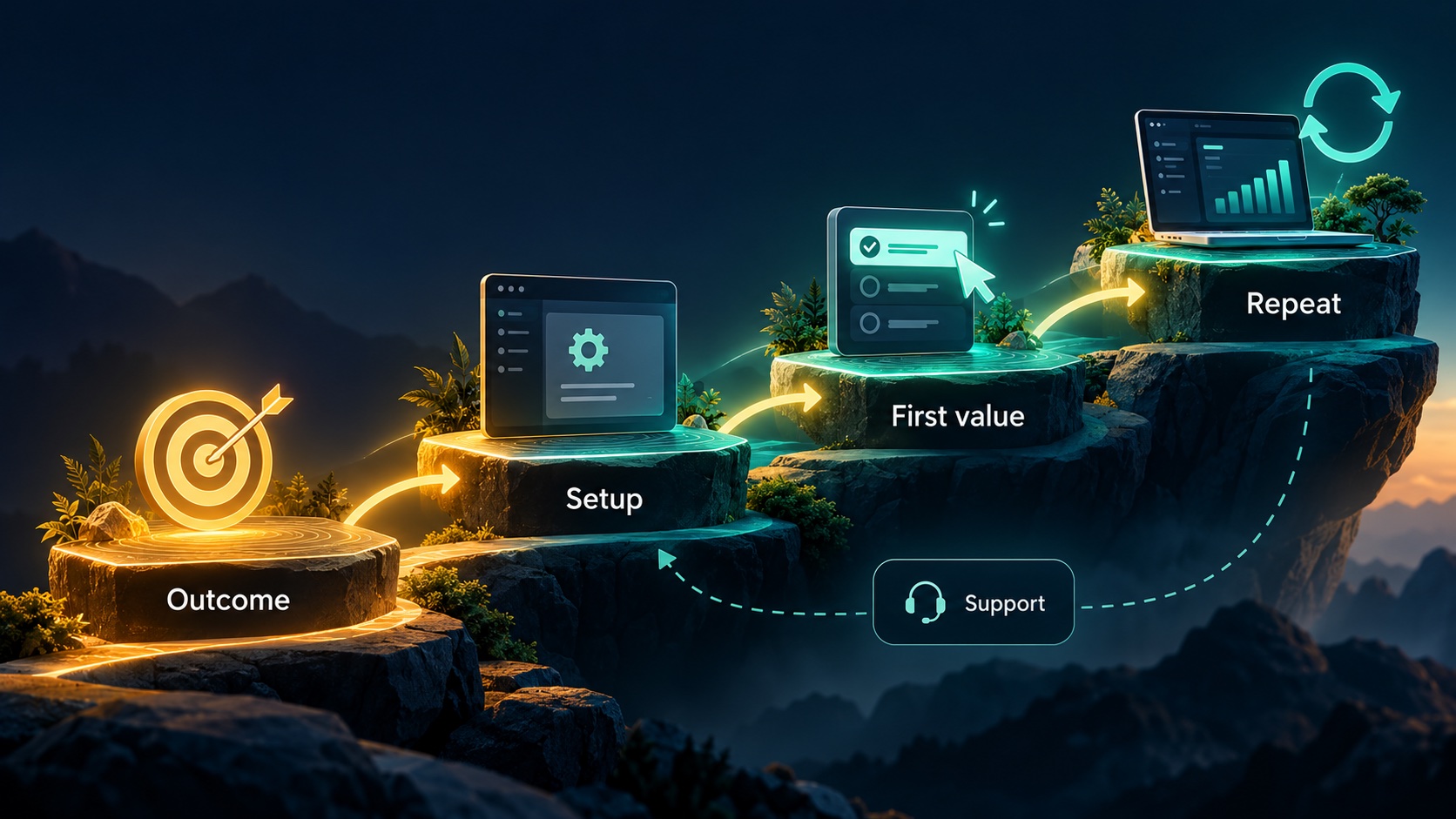
Onboard your first paying B2B SaaS customers by agreeing on one useful result and helping them reach it with their own workflow. A tour of every feature is usually less valuable than completing the task that motivated the purchase. The onboarding process should also reveal what prevents customers from succeeding independently.
Early assistance is useful when it produces learning and a repeatable path. Record what you explain, configure, and repair so the next customer benefits from product improvements rather than requiring the same improvised session.
Agree on success before setup
Ask the customer what they need to accomplish first, who owns that result, and when the work normally happens. A daily approval tool and a monthly reporting tool have different natural timelines. Do not impose a generic activation deadline without understanding the business rhythm.
Define a result that both sides can observe. For a hypothetical subcontractor portal, the first result might be one completed handoff: a coordinator submits a work package, a contractor provides the requested evidence, and the coordinator accepts it. Creating an account is a prerequisite rather than the outcome itself.
Keep the agreement compact. Record the workflow, the customer owner, the people involved, required inputs, and how completion will be recognized. Clarify any assistance included in the purchase so a guided setup does not silently become an open-ended implementation project.
Prepare the minimum useful workspace
Collect only the information required for the first result. A customer may need a workspace name, one owner, one collaborator, and a small set of real records. Advanced categories, historical imports, and custom reports can wait unless they are essential to the promised workflow.
Decide which setup steps the customer should perform and which you will assist with. Have the customer control their credentials and provider accounts. Use supported access paths for assistance and keep sensitive data out of shared notes, screenshots, and informal messages.
Make sample content recognizable. It can explain a workflow, but it should not be confused with customer records or counted as completed work. Give the customer an easy way to start clean when they are ready to use their own information.
Guide a real task with restrained help
Begin the session by restating the agreed result and asking the customer to perform the task. Observe where they hesitate, misunderstand a label, or need outside information. Give help when needed, but distinguish a genuine product success from a result achieved because you directed every click.
GOV.UK's guidance on moderated usability testing recommends realistic tasks with clear goals that do not reveal the method of completion. That principle is useful during onboarding observation: describe the outcome and learn how the customer tries to reach it.
In the subcontractor example, ask the coordinator to send a work package to a contractor. If they search for a share action instead of an invitation action, record the mismatch. The observation may suggest better language or a clearer first-run path, rather than a need for another tutorial video.
Support everyone in the workflow
B2B onboarding often involves several roles. The buyer, workspace owner, daily user, and external collaborator may be different people. A successful owner setup does not prove that the invited participant understands their part.
Follow the invitation from the recipient's perspective. Check that the message explains the organization, the requested action, and how to get started. After sign-in, the recipient should arrive with enough context to continue the specific task rather than face an unfamiliar empty dashboard.
For the hypothetical portal, the contractor may only need to upload evidence and submit it for review. Keep that path clear even if the coordinator has a much broader interface. Success depends on the whole handoff, so measure and observe both sides.
Classify obstacles before choosing a fix
An onboarding problem can be a defect, confusing interface, missing prerequisite, unsupported workflow, or mismatch between the offer and the customer. These categories suggest different actions. A failed upload requires investigation; a missing internal reviewer may require customer coordination.
Keep a short obstacle log with the step, observable symptom, impact, temporary assistance, and proposed permanent change. Record whether the issue affected one customer's unusual process or is likely to recur across the intended segment.
Be explicit when a requested behavior is outside the current scope. Offer a workable supported path if one exists, and record the request for product evaluation. Avoid promising a custom feature during every onboarding call before understanding the development and support cost.
Confirm independent continuation
Before ending the first session, ask the customer to explain or perform the next likely task. This is a practical check that they understand the workflow, where to find its state, and how to recover from ordinary mistakes.
Agree on the next real usage point. A reporting customer may return when a new reporting period closes; a task approval customer may use the product tomorrow. Schedule any follow-up around that business event rather than sending generic reminders disconnected from their work.
Provide a concise handoff containing the agreed result, what is complete, what remains, and the support route. Link to the relevant product guidance instead of sending a large documentation collection. The customer should know what to do next without reconstructing the entire session.
Turn assistance into a repeatable system
Review your first customers together. Look for repeated explanations, configuration tasks, permission mistakes, and stalled handoffs. Prioritize changes that reduce a recurring obstacle while preserving a clear product scope.
Track completed first results, time to result, assistance required, and whether the customer repeats the workflow. Keep counts visible when the sample is small. A handful of enthusiastic sessions is useful feedback, but continued use provides stronger evidence that the workflow fits the customer's routine.
Use the onboarding and workspace foundations described in Agentium Start's capabilities to organize the experience, then shape it around your customer's actual first result. The goal is a customer who understands the product well enough to continue useful work with a clear path to help when needed.
Authority References & Sources: