
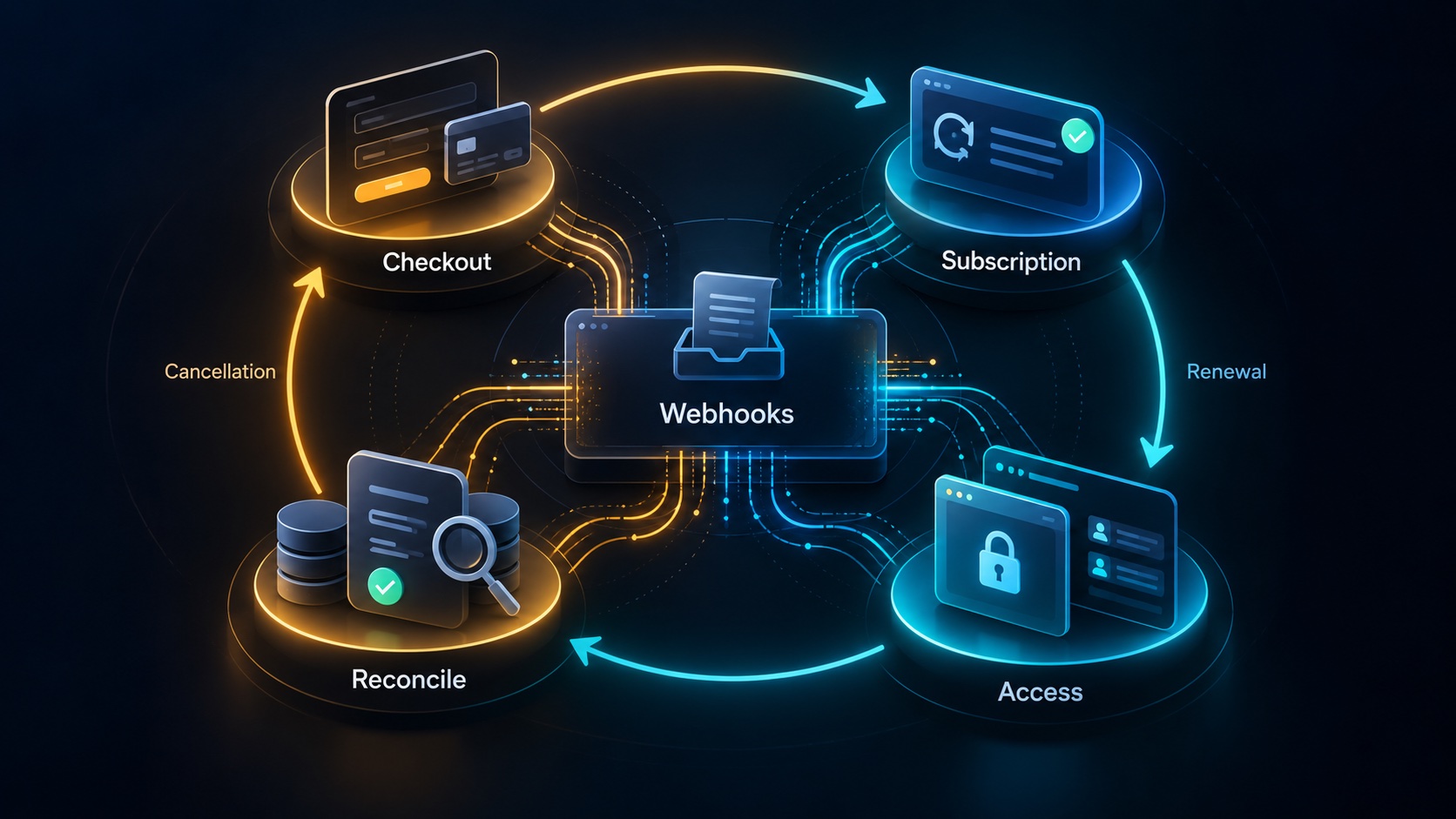
The first successful payment is a useful milestone. It is not the whole subscription lifecycle. Before relying on a billing integration in a SaaS starter, define what your application should do when the customer changes plans, a notification is delayed or processing fails.
Paddle documents webhooks as notifications that let your application respond to billing events. The business behavior attached to those notifications still belongs to your implementation. This article is an evaluation checklist, not a claim that any specific release has passed every scenario.
Separate three things
First, the vendor selling the source kit may use Paddle for its own checkout. Second, the kit may include a Paddle integration for the application you build. Third, your own business needs the provider account, configuration and approvals relevant to operating live payments.
Success in the first does not prove the second or complete the third. Ask the seller exactly which capability the product description refers to.
Decide who owns the subscription
A subscription might belong to an individual account, a workspace or another organization entity. The application needs a clear rule. Who may change it? Which members receive the associated entitlement? What happens after ownership transfer?
A billing page that looks personal while the subscription is workspace-wide can create confusing decisions. Follow the actual records and permissions behind the interface.
Define the lifecycle, not only checkout
List the states your product supports: initial purchase, active access, scheduled cancellation, failed renewal, recovery and any supported trial or grace period. Write the expected application behavior for each.
A downgrade also needs a rule for existing resources. Blocking new creation is different from deleting records or removing all read access. The application should not invent that policy in the webhook handler.
Review event processing
Ask how the application authenticates incoming notifications and records processing progress. Consider repeated delivery, delayed events and an interruption after receipt. The exact provider contract matters; consult the current documentation rather than assume events arrive once in the ideal sequence.
A useful recovery process should make failed processing visible and avoid accidental repeated business effects. Keep a trail that helps an operator understand what happened without exposing unnecessary customer information.
Check the entitlement where work happens
A pricing card is presentation. The protected application operation should follow the entitlement and permission policy. When an operation consumes a limited resource, test the relevant server-side enforcement, including simultaneous requests where appropriate.
A quota counter that displays a number is not the same thing as a reliable usage limit. Advertise only the limits the current release genuinely implements.
Rehearse recovery with safe data
Use the provider’s supported test tools and synthetic accounts. Record the version, environment, expected state transition and actual result. Keep an unresolved case visible rather than skipping it in the demo.
Do not manipulate real customer payments to make a marketing video. Where a production verification is necessary, perform it under an explicitly authorized operational process.
Know what the buyer still configures
Credentials, product/price mapping, event destinations and environment settings need to match the buyer’s own deployment. A kit cannot promise that merchant approval, identity verification or business rules vanish because the source is integrated.
Agentium Start’s current materials identify a Paddle Billing reference path. Review the exact supported scope at Agentium Start and the current provider documentation at Paddle webhook documentation.
Disclosure: Agentium Labs makes Agentium Start. This article explains questions to ask about a billing integration; it is not independent verification of a product or a guarantee about your live payment readiness.
Related guides
Continue with reliable, idempotent billing webhooks and the total ownership budget.