
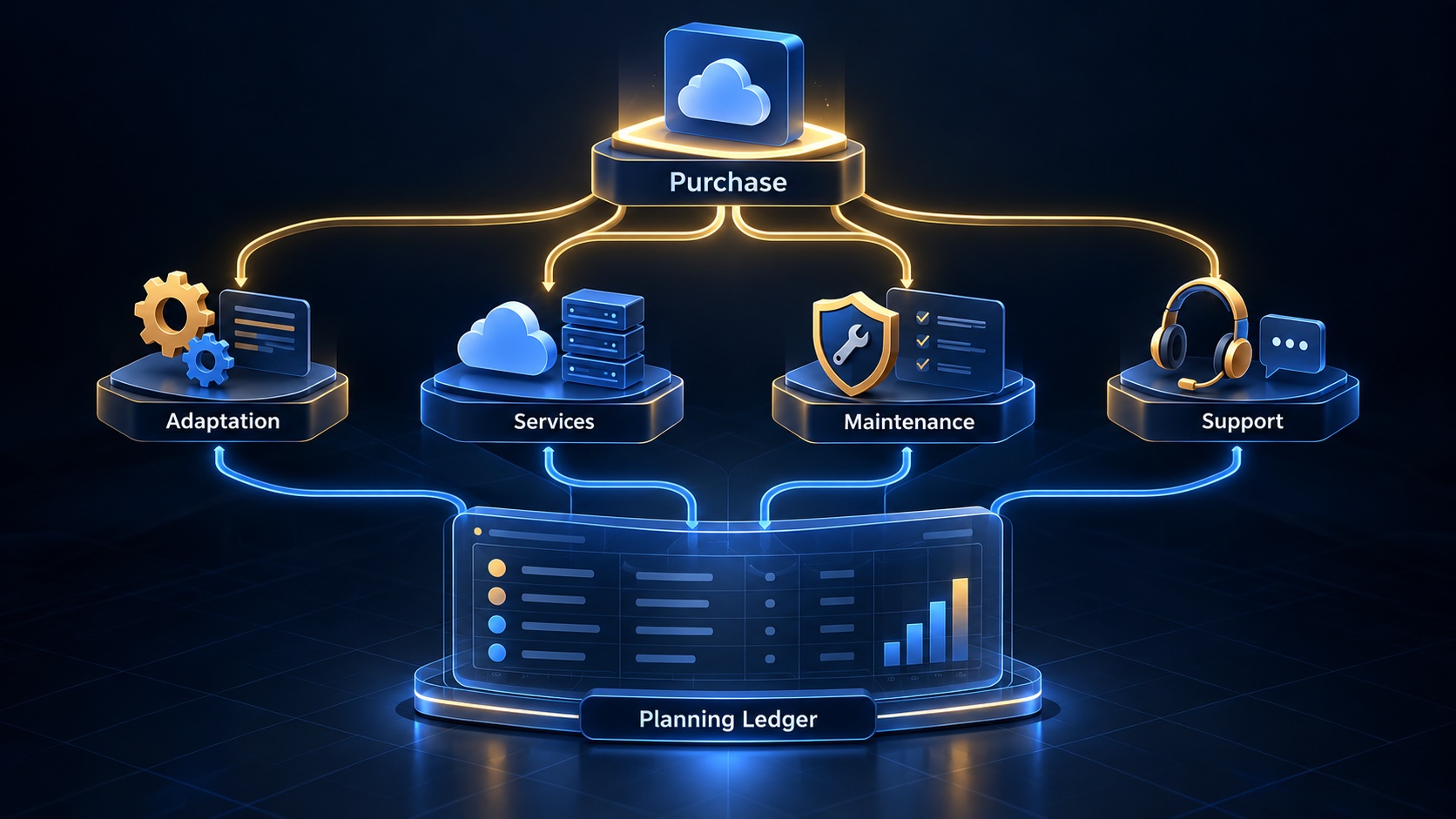
The total cost of owning a SaaS starter kit includes the source license, the work to adapt it, recurring application services, and ongoing maintenance. The license is usually the easiest number to find. The more important planning exercise is identifying what your application will consume and who will do the work after purchase.
Separate cash expenses from the value of your time. Both matter, but combining them without explanation can make a lean product appear either misleadingly inexpensive or unnecessarily expensive.
Start with the terms of the source purchase
Record the edition, permitted developer access, intended use, source-update period, and included support. Check whether client delivery requires a different license. Read the actual terms rather than assuming that source access grants every possible redistribution right.
The Agentium Start pricing page distinguishes source licensing from third-party operating expenses and describes its included update and support windows. Use the current offer when making a purchase decision because commercial terms can change.
Keep implementation services separate. A scoped setup engagement may help configure a reference deployment, while custom features, data migration, and ongoing operations require their own agreement. A source purchase should not silently become your budget for the entire finished business.
Estimate the cost of adaptation
List what you expect to retain and what you must change. Common adaptation tasks include branding, provider configuration, plan definitions, business objects, permission rules, customer onboarding, and deployment preparation.
Changes to the foundation can be more involved than changes to appearance. Replacing a billing provider or customer model may affect several workflows. A new logo is a different kind of task from changing how subscriptions determine team access.
Use a small implementation exercise to improve the estimate. Add one representative domain object and trace it through creation, authorized access, and an important state change. Record where the code helps and where additional work appears.
Include time to inspect the delivered application. Even a well-matched kit becomes your team's responsibility to understand. That learning has value because it improves future maintenance, but it still belongs in the plan.
Inventory recurring services
Map the services needed to run the actual release: application hosting, database, email delivery, file storage, monitoring, background work, and a domain. Add payment-related charges and AI or other metered APIs when your workflow uses them.
For each service, record the pricing unit, a current quoted rate from the provider, an estimated usage range, and the person who owns the account. Some costs are fixed within a plan; others grow with requests, storage, messages, processing time, or transferred data.
Do not assume development usage predicts customer usage. A file-heavy portal, an export tool, and an AI writing assistant have different cost drivers even when they start from the same codebase. Identify your likely dominant driver early so you can measure it after release.
Build an illustrative annual model
Consider a hypothetical internal-reporting SaaS. For planning only, assume a $300 source license, $60 per month of combined infrastructure, eight hours of setup, and one hour of maintenance each month. Value the founder's time at an illustrative $50 per hour. These invented amounts are not Agentium Start prices or current provider quotes.
| Cost category | Illustrative basis | Annual amount |
|---|---|---|
| Source license | One purchase in year one | $300 cash |
| Infrastructure | $60 × 12 months | $720 cash |
| Initial setup | 8 hours × $50 | $400 time value |
| Maintenance | 12 hours × $50 | $600 time value |
The illustrative first-year cash expense is $1,020. The separate value of founder time is $1,000, making the combined planning total $2,020. The setup time is counted once; maintenance is counted across twelve months.
This example excludes additional feature development, payment fees, taxes, customer acquisition, and usage above the assumed service budget. Add those items when they apply. Do not treat the example as a forecast or a quote.
Compare options with the same acceptance criteria
Compare a source kit, a visual platform, and a custom implementation against the same paid workflow. Include permission checks, billing behavior, deployment, and the ability to maintain the application after launch. A cheap demonstration and an operable customer release are different scopes of work.
For each option, keep three estimates: a likely case, a higher-usage case, and a case with more adaptation than expected. Record the assumptions you can test with a small pilot. Replace estimated operating costs with observed usage after the first customers arrive.
Use this worksheet before purchasing:
| Decision | What to record |
|---|---|
| Source and rights | Edition, developer access, client delivery rights, update and support windows |
| Adaptation | Required changes, owner, estimate, and acceptance checks |
| Services | Pricing unit, usage range, current provider quote, and account owner |
| Operations | Monitoring, backups, maintenance time, and incident responsibility |
| Exclusions | Work or charges that the initial estimate does not cover |
If you are comparing Agentium Start, review its current commercial terms and capability scope, then test one representative workflow. Buy the foundation that fits your product and operating capacity, with a budget that makes the remaining work visible.
For related evaluation questions, read starter kit vs no-code for B2B applications and agency client handover responsibilities.
Disclosure: Agentium Labs makes Agentium Start. All amounts in the annual model are invented planning inputs, not product prices, measured savings, or provider quotes.