
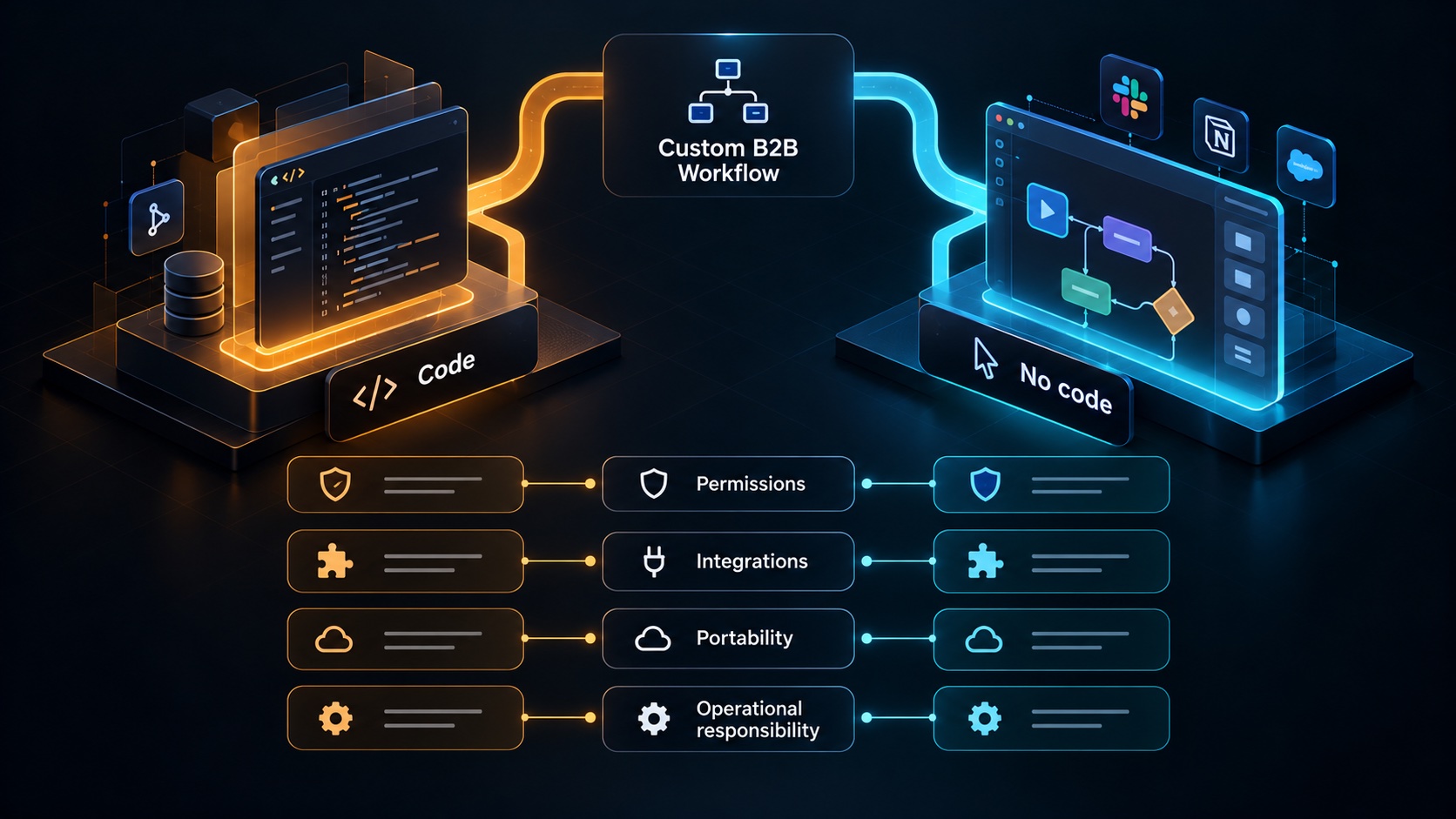
A SaaS starter kit suits a team that wants to modify and operate application source. A no-code platform suits a team whose required workflows fit the platform's available data, interface, automation, and access controls. The better choice depends on the application you need and the people who must maintain it.
Avoid treating this as a contest between technical and nontechnical founders. A visual builder still requires careful product decisions. A source kit still requires engineering skill. Both approaches need a working customer model, clear permissions, and a dependable route from user input to business outcome.
Start with the hardest ordinary task
List the daily task customers will pay to complete, then identify its most difficult routine variation. This is often more revealing than the simplest demonstration.
For a training provider portal, a basic task might be uploading course material. The harder variation could involve a corporate customer assigning employees to training, a trainer seeing only assigned groups, and a manager reviewing completion across several departments. Add an employee changing departments midway through a course.
Evaluate that variation in each candidate. Can the data relationships express it cleanly? Can the interface make it understandable? Can permissions be enforced whenever the data is requested? You want to discover fundamental constraints before building the rest of the product around an easy demo.
Locate control and responsibility
With a visual platform, inspect the specific provider's facilities for custom logic, integrations, background work, deployment, and data export. These capabilities vary, so broad claims that all no-code tools support or lack a feature are unhelpful.
With a source kit, you can generally change the application code within the license, but your team must review those changes and operate the resulting product. Hosting, credentials, provider configuration, dependency updates, and production incidents still need owners.
Agentium Start's source-kit offer uses Next.js, Prisma, and PostgreSQL as its application foundation. Its branded browser preview helps demonstrate sample flows; it does not create a hosted business application for the visitor. That distinction is useful when comparing it with a platform that provides an application runtime as part of its service.
Examine permissions beyond screen visibility
B2B permission rules often depend on a relationship between the actor and the record. A trainer may access one cohort; a customer manager may access several cohorts within one organization. Hiding navigation alone cannot express the complete security boundary.
For either development approach, inspect how access is enforced on direct requests, exports, uploads, and automated tasks. OWASP's authorization guidance distinguishes identity from permission and recommends validating access for each request. Ask your platform or codebase to demonstrate the equivalent behavior.
Use two fictional organizations during evaluation. Attempt to open a record, download a file, and trigger an operation from the wrong organization. Then remove a user and repeat the attempts. These checks reveal whether the permission model follows the data across different interfaces.
Price the integration work realistically
Consider every outside system the application must call. Identify the authentication method, data direction, failure handling, synchronization frequency, and person responsible when the integration stops working. A connector's existence does not prove it covers your exact operation.
Suppose the hypothetical training portal must import employee rosters from a customer's HR system. Begin with a supported file import if that satisfies the first paid workflow. If automated synchronization is essential, test deactivated employees, renamed departments, repeated records, and interrupted imports before committing.
A no-code implementation may handle the requirement cleanly through available actions and custom extensions. A source implementation may need new provider code. Compare the work required by your actual integration, including review and support, instead of counting advertised connectors or available packages.
Consider portability before the product grows
Separate several kinds of portability. Can you export customer data in a usable structure? Can you move uploaded files? Can another system reproduce the workflow? Can a future team understand the business rules? Can you change hosting without rebuilding the interface?
Do not assume data export means the whole application is portable. Equally, a repository does not remove dependency on its framework, cloud services, or original conventions. Source access makes some changes possible, while the cost of making them remains a planning question.
Create a small exit exercise. Export one training customer with its groups, memberships, assignments, and completion records. Check whether relationships and identifiers survive. Keep the exercise proportional to the product's stage; the goal is to expose hidden dependencies before they become large.
Match the approach to your team's capacity
A founder who cannot yet review server code should account for engineering help when buying a source kit. An experienced developer who chooses a visual platform should account for learning its workflow model and constraints. Familiarity can outweigh small differences in feature coverage.
Build a narrow prototype using the hardest ordinary task and ask the future maintainer to modify it. Change a permission, add one field, adjust a workflow state, and diagnose a failed operation. This exercise tests maintainability more directly than a feature checklist.
If the product fits a visual platform cleanly, that may be a sensible first implementation. If custom behavior and source-level control are central, compare the Agentium Start capability scope with your requirements. Choose the approach that lets your team deliver the workflow responsibly and continue changing it as customers teach you what matters.
Authority References & Sources:
Related guides
Compare the total ownership budget alongside the agency handover questions before selecting a foundation.