
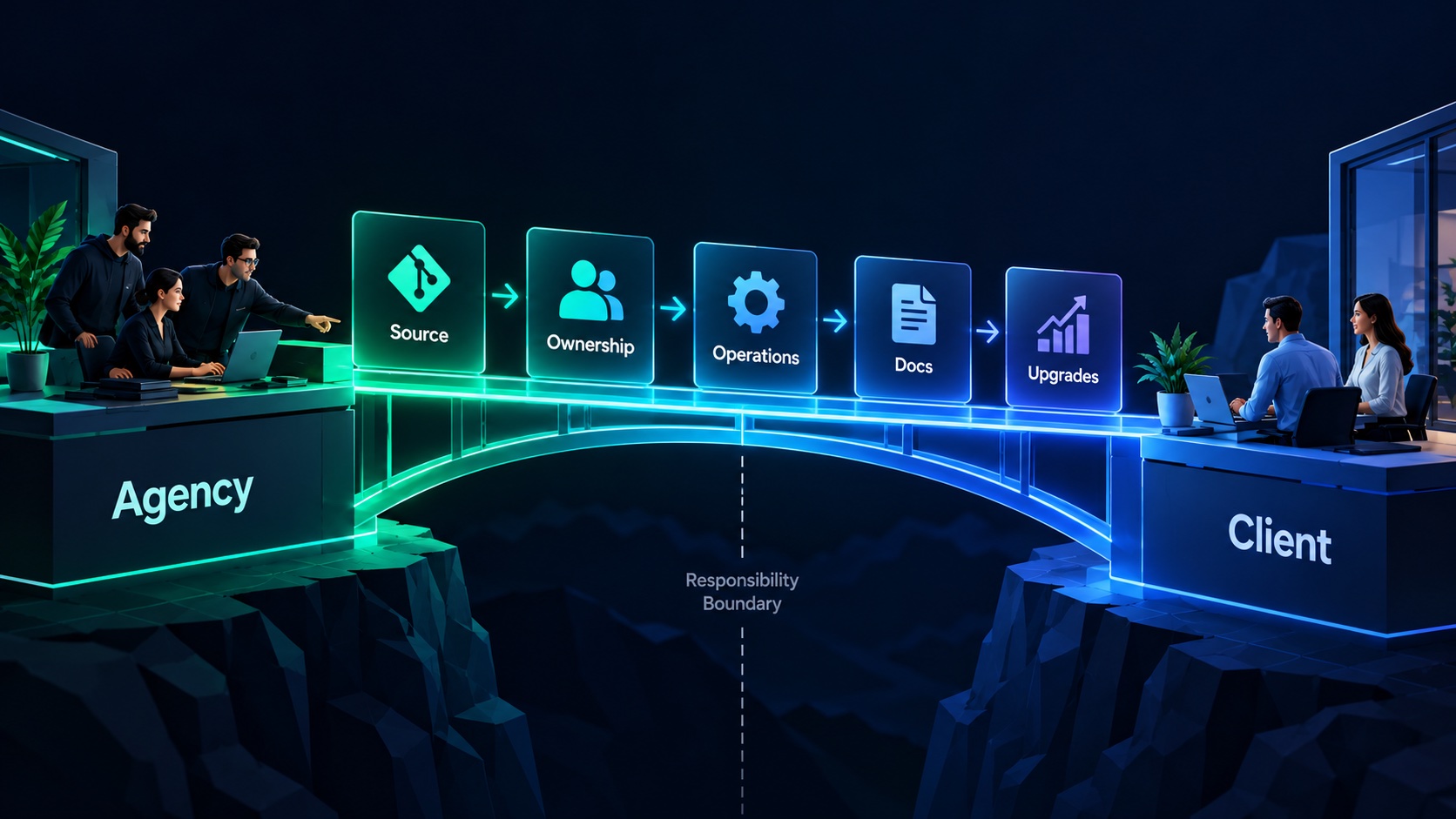
For an agency, a SaaS starter is not only a shortcut on the first project. It can become a repeatable way to deliver client applications. That makes the handover, maintenance and source rights as important as the initial UI.
This guide is a commercial evaluation checklist, not legal advice. Read the actual license for the product you purchase and obtain legal advice where needed.
Separate developer seats from customer accounts
A source-kit developer seat usually concerns who works with the reusable code. It is a different question from how many end users, customer workspaces or tenants exist inside the resulting application.
Check how the license treats employees, contractors, replacement team members and separate organizations. Do not infer unlimited source access from an “unlimited projects” phrase.
Clarify the client handover
Ask whether the agency may deliver a completed application’s source to the client, what the client may maintain and whether the client may use the underlying kit for unrelated products. Those are separate rights.
A promise to build client projects should match the written handover rules. When the license restricts redistribution of the starter itself, understand how that differs from delivering the application you built with it.
Know who owns the operational accounts
Decide whether hosting, database, email and billing accounts belong to the client or the agency. Document how access is granted and later removed. Avoid relying on a developer’s personal account as an undocumented production dependency.
A handover should identify the deployment, configuration ownership, backup approach, monitoring responsibility and update process. Do not send credentials in a public project document or screen recording.
Make the first custom feature repeatable
A familiar architecture can reduce the time spent relearning each project. That advantage disappears when every delivery becomes a different fork with undocumented changes.
Use supported extension points where practical. Keep the client-specific policy clear, record the actual diff and rerun the relevant checks. AI tools can assist, but the resulting application still needs a maintainable structure.
Define what “support included” means
Product support for a source kit is not automatically a retainer for your client’s custom application. Understand the difference between fixing a reproducible kit issue, configuring the supported environment and implementing a new business workflow.
Tell the client which obligations your agency takes on. Do not sell an ongoing service based on an assumption that the kit’s vendor will perform all of the work.
Plan upgrades before the first delivery
Review release notes and migration instructions. Keep track of the base version and the customizations applied. Test updates against the client’s workflow before production, especially where data or external integrations change.
The easiest demonstration is a fresh application. The more important maintenance question is what happens after the client has real data and your team has changed the source.
Evaluating Agentium Start
Agentium Start offers Core for licensee-owned applications and Agency for its documented team/client use. Assisted Launch is a scoped service, not a substitute for an ongoing client-maintenance contract. Confirm the current prices and terms at Agentium Start pricing.
Choose a starter whose architecture and rights fit the services you intend to sell. If the fit is uncertain, resolve it before accepting the client project—not at handover.
Disclosure: Agentium Labs makes Agentium Start. This article explains evaluation questions and does not replace the authoritative license or establish the terms of other products.
Related guides
Budget the ongoing work with the total ownership worksheet, and review the Paddle billing checklist when the client application needs subscriptions.