
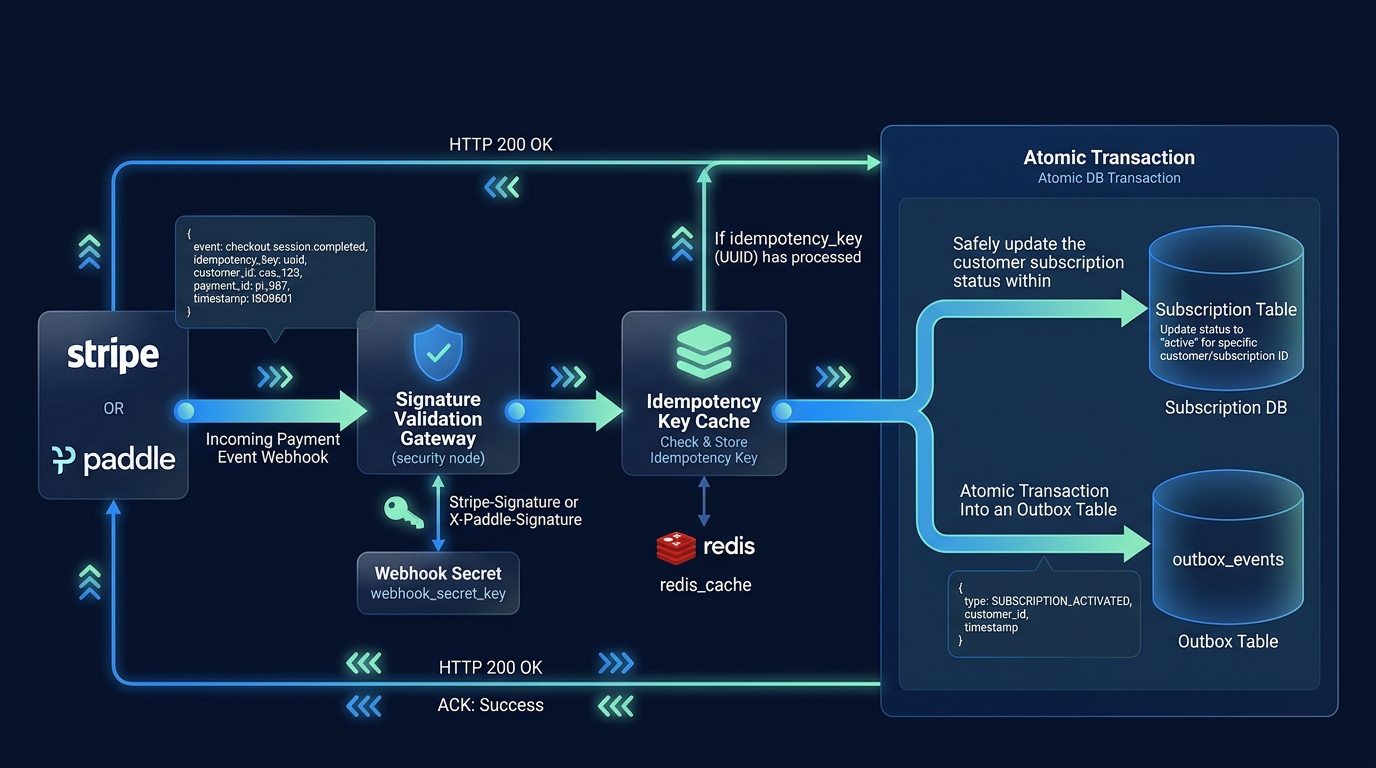
Billing webhook idempotency means that receiving or retrying the same billing event does not produce unintended additional effects. A duplicate subscription update should not grant credits twice, send several identical messages or create another customer record.
Reliability requires more than remembering an event ID. The application must preserve the event, apply its business changes safely, acknowledge receipt at the right point and recover when any step fails. Design those transitions before connecting the handler to production payments.
Know what the provider promises
Paddle's webhook event model describes at-least-once delivery, identifies event_id as the deduplication key and recommends occurred_at when handling out-of-order events.
An event and a notification are different concepts. Use the identifier for the underlying business event when preventing duplicate application processing, rather than assuming each delivery represents new work.
A practical event record can contain the provider, environment, event ID, event type, occurrence time, receipt time and processing state. Preserve the source data needed for investigation under an appropriate retention policy.
Separate occurrence time from receipt time. They answer different operational questions: when the billing change happened and when your application learned about it.
Verify before trusting the payload
Anyone who can reach a public endpoint may attempt to submit a request. Verify the provider's signature before allowing the payload to alter billing or access state.
Paddle's signature verification guide requires the appropriate destination secret and the original request body. Parsing and reserializing JSON can change the bytes used for verification, so preserve the raw body until verification is complete.
Keep the receiver's environment configuration explicit. A sandbox event should not update a live customer's access. The correct verification secret, provider account mapping and environment should agree.
After verification, validate that the event type is one the application supports and that required identifiers are present. An unfamiliar event should have a deliberate handling path rather than accidentally reaching generic account-update logic.
Acknowledge after durable receipt
Consider a hypothetical analytics subscription service. The webhook endpoint receives a valid renewal event and starts updating the customer's allowance. If the server crashes before storing the event, an early success response may leave no recoverable record.
A useful design first stores the event in a durable inbox with a pending state. Once that write succeeds, the receiver can acknowledge receipt, and a worker can process it independently.
A duplicate delivery should find the existing inbox record through a uniqueness rule. It can acknowledge a durably stored event without inserting another copy or rerunning completed work.
Do not confuse stored with applied. An event may be received successfully but still need processing. Keeping separate states lets an operator see whether the issue is delivery, business logic or a failed downstream service.
Apply the business change atomically
Suppose processing a renewal grants an allowance and marks the event complete. Those two database changes should not be allowed to disagree.
If the allowance changes but the completion marker is lost, retrying may add the allowance again. If the event is marked complete before the allowance changes, a failure may suppress the legitimate update.
Use a transaction or equivalent concurrency control to coordinate the business update with its processing marker. PostgreSQL's transaction isolation documentation explains the concurrency behavior that makes deliberate transaction design necessary.
Also protect the business occurrence itself. Two different provider events may refer to the same renewal or purchased item. A unique event ID prevents replay of one event; it does not automatically prevent two event types from independently granting the same allowance.
Prevent older state from replacing newer state
Imagine the application processes a cancellation update before an earlier plan-change update arrives. Applying both snapshots blindly can restore an obsolete state.
For entity snapshots, compare the provider's occurrence information with what the application last applied, and serialize competing updates to the same subscription. Keep a record of skipped stale updates so the decision is explainable.
If events have equal timestamps, missing context or incompatible information, do not invent an ordering from arrival time. Retrieve current provider state or send the account through reconciliation.
Avoid treating every event as a complete snapshot. Some events describe an independent business occurrence that still requires processing even if a later subscription update has already arrived. State replacement and one-time effects need different rules.
Protect external side effects separately
A database transaction cannot make an external email or provider request disappear if the application later crashes. This creates another failure boundary.
An outbox can record the intended side effect alongside the related database change. A separate sender then delivers the message and records the result. Give the side effect a stable business identifier so retries can be recognized.
For the analytics service, the identifier might represent one renewal notification for one subscription period. It should remain the same across retries. Generating a new identifier on every attempt defeats deduplication.
Even with an outbox, understand the external provider's behavior. A request can succeed while its response is lost. Where supported, use provider idempotency keys. Otherwise, design a recovery process that investigates ambiguous outcomes instead of promising impossible certainty.
Give failures an operator path
Record processing attempts, last error category, affected subscription and whether a retry is safe. Distinguish temporary provider failures from invalid mappings or unsupported event data that need investigation.
Offer controlled replay after the underlying issue is resolved. Replaying should pass through the same idempotent business operation, not a separate shortcut that ignores existing receipts.
Test duplicate delivery, concurrent processing, a crash after receipt, a crash during mutation and an external call that succeeds before timing out. Then verify that reconciliation can restore agreement with the billing provider.
Use the Agentium Start feature scope when reviewing the reusable billing foundation. Trace your own plan changes and allowances through receipt, processing and recovery so the integration remains understandable under failure as well as during successful checkout.
Authority References & Sources: