
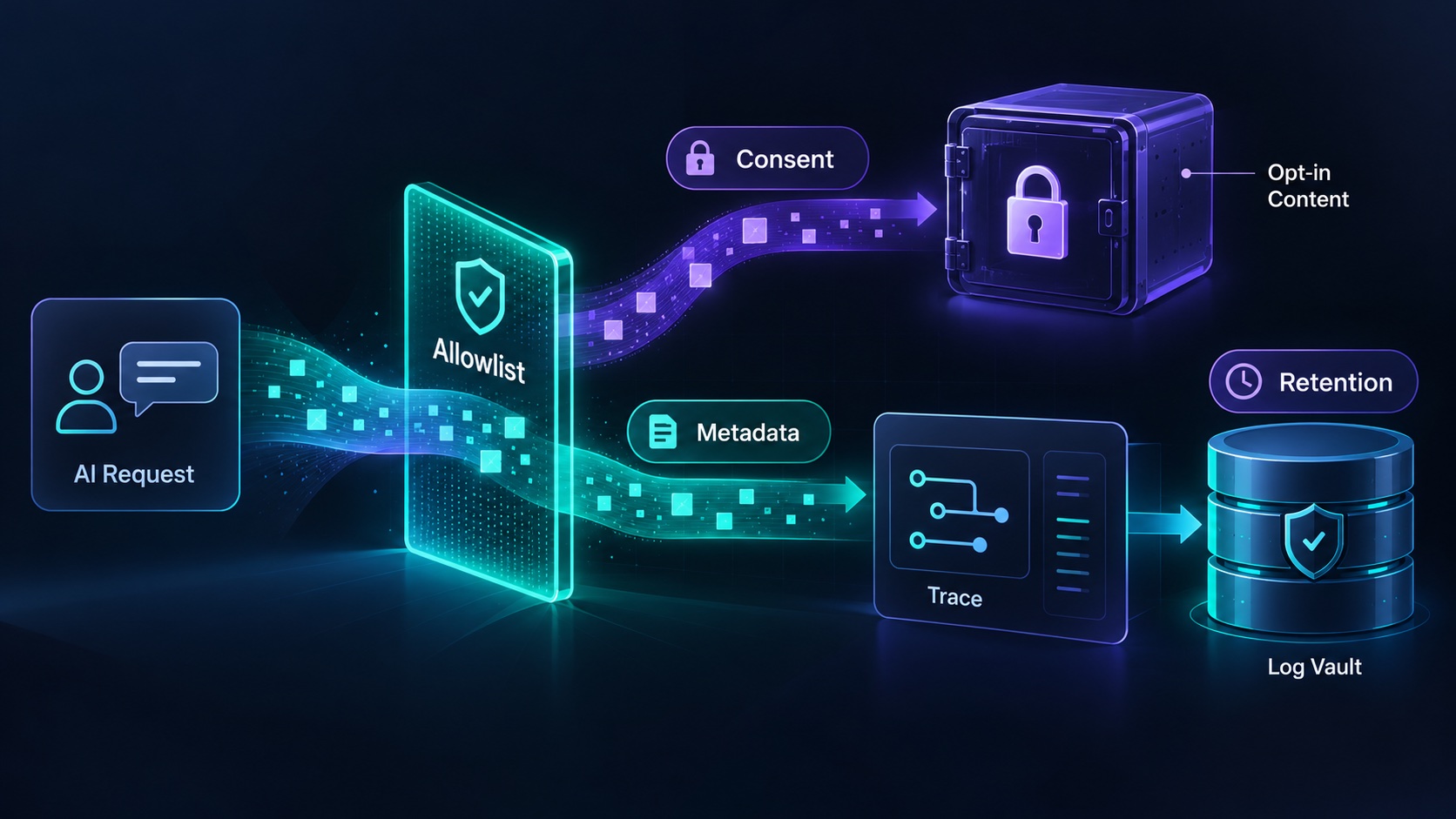
Privacy aware logging for an AI SaaS starts by deciding what operators need to diagnose and recording the smallest useful event for that purpose. Most requests can be monitored through identifiers, timing, status, configuration versions, and usage counts. Raw prompts, retrieved documents, and model outputs deserve a separate, deliberate collection decision.
This matters because an AI workflow can move customer content through several components. Your application logger may be careful while an error tracker, tracing tool, analytics event, or support export captures the same content elsewhere.
Define the operating questions first
List the questions you expect to answer during a problem. Did the request pass authorization? Which workflow version ran? Which provider attempt failed? Was the output rejected by validation? Was the customer allowance deducted correctly?
These questions do not automatically require the complete customer conversation. They often require a request identifier, workspace reference, operation type, error category, timestamps, and the final state.
Consider a hypothetical AI proposal assistant. An operator investigating a missing result needs to know whether the document was accepted, processing began, the provider responded, validation passed, and the result was stored. Begin with those events before deciding that every proposal must be copied into a logging system.
Create an allowlist of metadata
Define permitted log fields for each event. Useful examples include operation identifiers, internal workspace identifiers, provider and model configuration identifiers, prompt-template versions, duration, usage totals, and validation error codes.
Treat identifiers as access-controlled data too. Replacing an email address with a stable internal reference reduces unnecessary exposure, but the reference may still be linked to a customer through your systems.
The OWASP Logging Cheat Sheet recommends excluding or specially protecting data such as access tokens, session values, and sensitive personal information. Apply that principle to AI inputs and outputs, where those values may appear inside otherwise ordinary text.
Prefer explicit event construction over serializing an entire request or provider response. An allowlist is easier to review than a growing set of exceptions attached to a generic object dump.
Separate content capture from routine logs
If a particular investigation requires content, design a restricted path with a stated purpose, narrow scope, appropriate authorization, and a defined expiration. Avoid turning a temporary debugging need into indefinite capture for every customer.
Use synthetic reproduction cases whenever possible. For the proposal assistant, recreate an input with the same structure and failure trigger but without the original client's commercial details. If the issue depends on exact formatting, capture the smallest relevant fragment under the approved process.
Record whether content was captured and why, without embedding it in ordinary event messages. Keep access limited to the people handling the investigation. Review the arrangement with the product's data practices and customer commitments in mind rather than assuming all debugging data is interchangeable.
Treat redaction as a layer
Redaction can reduce exposure, but its effectiveness depends on what it recognizes and where it runs. A filter built for obvious email addresses will not necessarily identify commercial strategy, a name embedded in a filename, or a secret split across several fields.
Remove known credentials and disallowed fields before sending events to external systems. Bound text lengths and handle malformed input so a logging path cannot become an easy route for uncontrolled content collection.
Test the process with synthetic examples containing access tokens, customer names, document titles, and unusual formatting. Inspect the actual emitted event, including error details and nested fields. A clean console message does not prove that a tracing attachment or exception object is equally clean.
Carry the policy across the workflow
Map where data can be copied: application logs, model traces, job payloads, analytics, error reporting, database debug output, browser recording, and customer support tools. Give each component an owner and a clear rule.
For the proposal assistant, the job record may need a reference to a stored document rather than the full document body. An analytics event can record that a proposal was generated without recording its title or content. An error report can include a validation code rather than the entire model response.
Also inspect the provider-specific request lifecycle and account settings relevant to your chosen services. Your own logging controls do not automatically describe what an external provider retains. Keep that assessment separate and current as integrations change.
Define retention and access operationally
Choose retention periods according to the purpose of each data category and the commitments you have made. Routine operational metadata, restricted debugging content, and customer-facing history may need different treatment.
Implement deletion or expiration in the systems where data actually resides. Check copies, exports, backups, and derived datasets when they are part of your architecture. Describe the real behavior accurately rather than promising an instantaneous disappearance your systems cannot demonstrate.
Limit operator access by role and record access to especially sensitive diagnostic material where appropriate. A useful logging system should help people resolve the problem without making broad browsing of customer content the normal support workflow.
Verify observability with a worked failure
Return to the hypothetical proposal assistant. A customer reports that generation stopped after processing. The operator follows one operation identifier, sees a completed provider attempt, a schema-validation failure, and an allowance release. The metadata explains the lifecycle and confirms that no approved result was stored.
The team reproduces the malformed field with a synthetic document, fixes the validator or generation configuration as appropriate, and adds a regression case. Raw customer content is only considered if the available evidence cannot resolve the specific issue and the controlled process permits it.
Agentium Start's feature scope lists structured logging as part of its foundation. Your AI event schema, content policy, and end-to-end verification remain application-specific work.
Use the Agentium Start documentation when connecting that work to the source kit. Design logs around the questions your operators must answer, then make every additional collection choice explicit.
Authority References & Sources: