
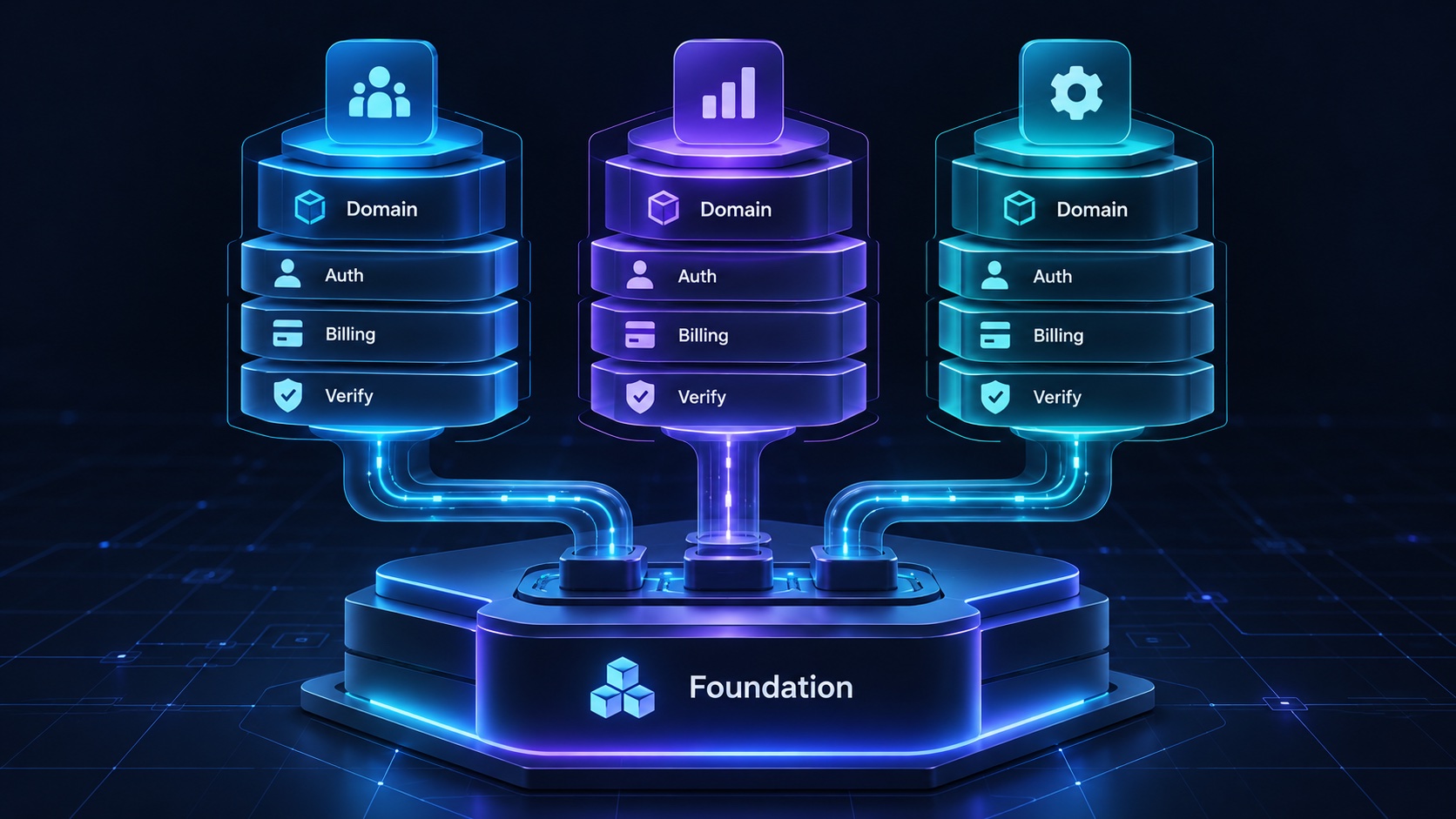
Every new SaaS product introduces unique challenges. Yet many applications repeatedly need the same foundational capabilities: identity, permissions, database access, billing, email, and deployment configuration.
A reusable foundation helps developers avoid solving every shared problem from scratch.
Focus Engineering on Differentiation
Your product's competitive advantage usually comes from the specific problem it solves, the customer experience, and the business workflow it enables.
Reusing suitable infrastructure can leave more time for these priorities.
Maintain Consistent Architecture
A structured codebase provides established conventions for new modules, configuration, and integrations.
This consistency can make future development easier for both human developers and AI coding agents.
Keep Verification in the Workflow
Reusable code still requires review, testing, and maintenance. Ensure that the foundation's limitations are understood and that your product-specific workflows are validated.
Retain Control
Evaluate source access, licensing, deployment options, and dependency choices. The foundation should support your intended operating model rather than create an unacceptable constraint.
Choose Reuse Deliberately
A reusable foundation is worthwhile when it fits your product and reduces more work than it introduces.
Conclusion
Building a SaaS product does not always require rebuilding the same infrastructure. Start with a suitable foundation, understand its boundaries, and invest your effort where your product can be different.
Agentium Start offers editable B2B SaaS source code, multi-tenant foundations, a Paddle billing reference path, reusable templates, and structured AI development recipes. Explore the Agentium Start homepage and feature catalog to decide whether it is the right starting point for your next application.