
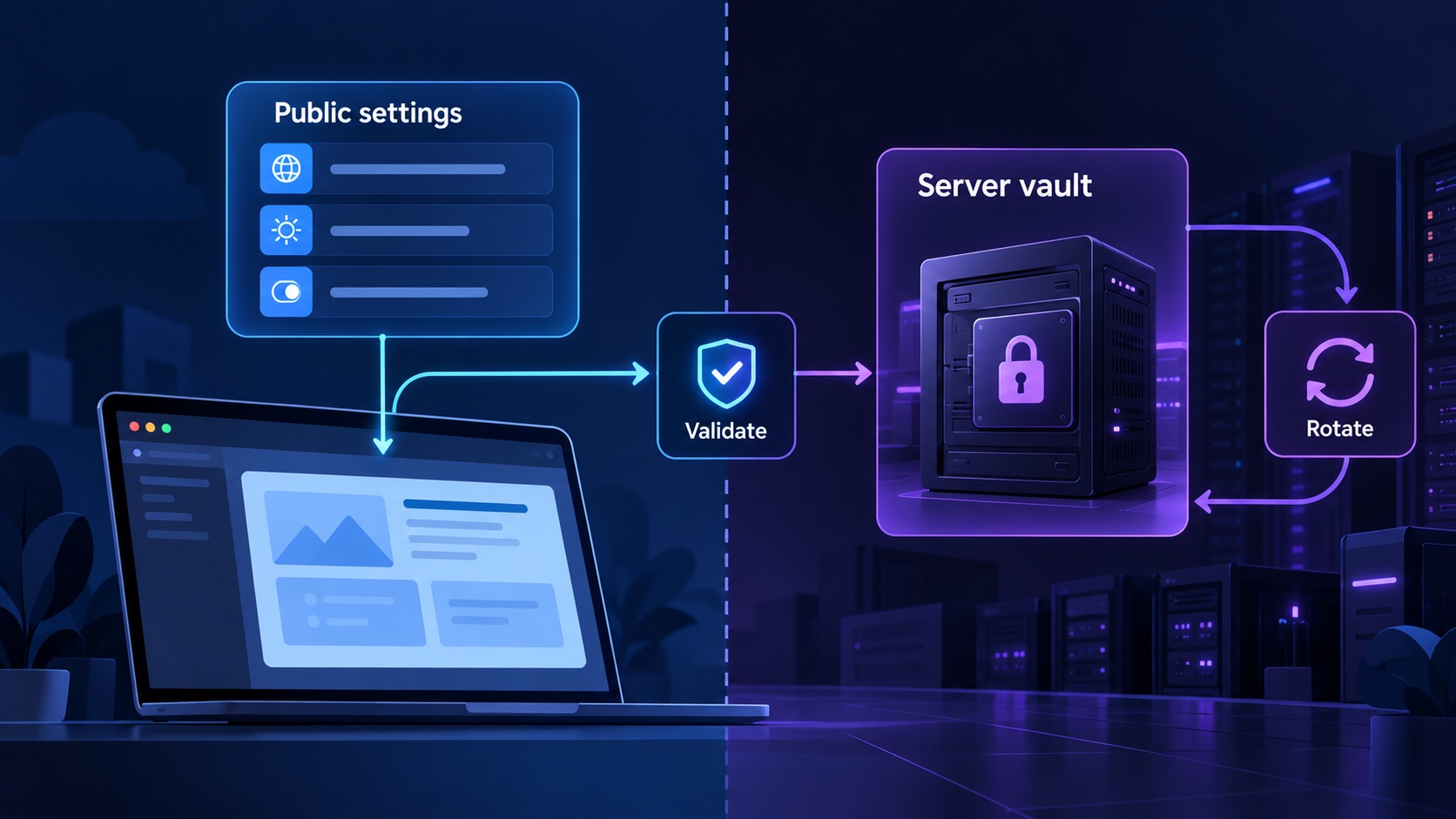
SaaS configuration management should make it difficult to run an application with the wrong database, billing account, or public URL. It should also make ordinary changes understandable: developers need to know which setting controls a behavior, where the value comes from, and whether changing it requires a new build or restart.
Treat configuration as an explicit interface between code and its operating environment. A growing collection of undocumented environment variables creates hidden dependencies that appear only when another developer sets up the app or a deployment reaches production.
Classify settings by purpose
Separate settings that define the product from settings that connect a deployment to external services. Navigation labels and supported feature names may belong in typed application configuration. Database endpoints, provider credentials, and deployment URLs need environment-specific handling.
Then distinguish public values from secrets. A public website origin or browser analytics identifier may be intentionally visible. A database password, server API credential, or webhook signing secret should remain available only to the server components that require it. A variable's convenient name does not determine its sensitivity.
Build a short configuration inventory containing purpose, owner, required environments, sensitivity, and change procedure. Include default behavior. A missing optional integration should produce a clearly disabled capability, while a missing credential for a required service should stop startup with a useful error.
Respect the browser boundary
Next.js can inline variables prefixed with NEXT_PUBLIC_ into browser JavaScript at build time. Its environment variable documentation also explains that those bundled values remain fixed after the build. Treat that prefix as a deliberate publication decision.
This matters when promoting the same artifact through environments. If the public billing mode or site URL was baked into the build, changing a runtime setting may not update the browser's value. Document which settings are evaluated during builds and which are read by the running server.
Review data crossing the server-to-client boundary as well. Avoid placing server configuration objects into rendered page props or diagnostic endpoints. Keeping a secret out of public environment variables does not help if an error page later serializes the same value into a response.
Validate settings before serving traffic
Parse configuration once through a defined schema. Check required strings, allowed modes, URL formats, numeric ranges, and combinations of settings. A timeout should become a validated number, not remain an arbitrary string interpreted independently by several modules.
Validate relationships too. A live billing mode should not point to a sandbox endpoint. An enabled file upload capability should have the necessary storage configuration. Required callback URLs should match the intended environment. These checks catch mistakes that isolated presence tests cannot.
Error messages should name the invalid setting and explain the expected shape without printing secret values. A startup report can show which services are configured and which optional capabilities are disabled. It should remain useful when copied into a support ticket without disclosing credentials.
Work through a billing configuration mistake
Imagine a hypothetical SaaS team preparing a staging deployment. The server uses a test billing account, but a public configuration value still selects the live checkout environment. The dashboard loads successfully, so a simple homepage check reports that deployment is healthy.
A better validation process checks the mode as a complete configuration group. The browser configuration, server account, price identifiers, and webhook destination must correspond to the intended environment. A controlled staging purchase then verifies the full application outcome, including the entitlement recorded in the correct database.
After fixing the mismatch, the team adds a documented invariant to its configuration schema and release procedure. It also makes the environment visible to operators. The goal is a preventable setup error that fails early, instead of a mystery discovered by the first customer.
Store and rotate credentials deliberately
Use an appropriate secret store for the deployment platform and restrict access by role or workload. Avoid passing production credentials through shared documents, screenshots, or committed example files. Local development should use separate credentials with the smallest practical scope.
Keep a rotation procedure for each important integration. Record who can issue a replacement, how the application receives it, whether overlapping credentials are supported, and how you confirm the old credential has been revoked. OWASP's secrets management guidance treats creation, rotation, revocation, and auditing as parts of a secret's lifecycle.
Practice rotation before an incident requires it. A credential leak is harder to contain when nobody knows which worker processes retain the old value or whether a restart is required. Where a provider supports it, use a controlled overlap and verify the replacement before removing the previous credential.
Keep examples useful without making them dangerous
Provide an example configuration file with meaningful descriptions and clearly synthetic values. Mark optional settings and explain what happens when they are omitted. Keep the example synchronized with the schema so a new developer can discover required services without reading every integration module.
Do not use a plausible production host as a harmless default. A setup script should require an explicit choice before connecting to a shared or production database. Give local and test environments unmistakable names so destructive reset operations can enforce their intended scope.
Configuration changes deserve review even when code stays unchanged. A new provider endpoint, expanded credential scope, or altered retention value can materially change application behavior. Record the relevant change history without storing secret contents in that history.
Establish one source of interpretation
Application modules should consume validated configuration rather than independently reading and coercing environment variables. This makes behavior easier to test and reduces inconsistent defaults. Keep the dependency direction clear so shared code accepts the settings it needs instead of reaching into unrelated application configuration.
Agentium Start includes typed configuration and strict environment validation in its published scope. Use those patterns to maintain a clear inventory for your integrations, then verify the complete configuration of each environment before serving customer work.
Authority References & Sources: