
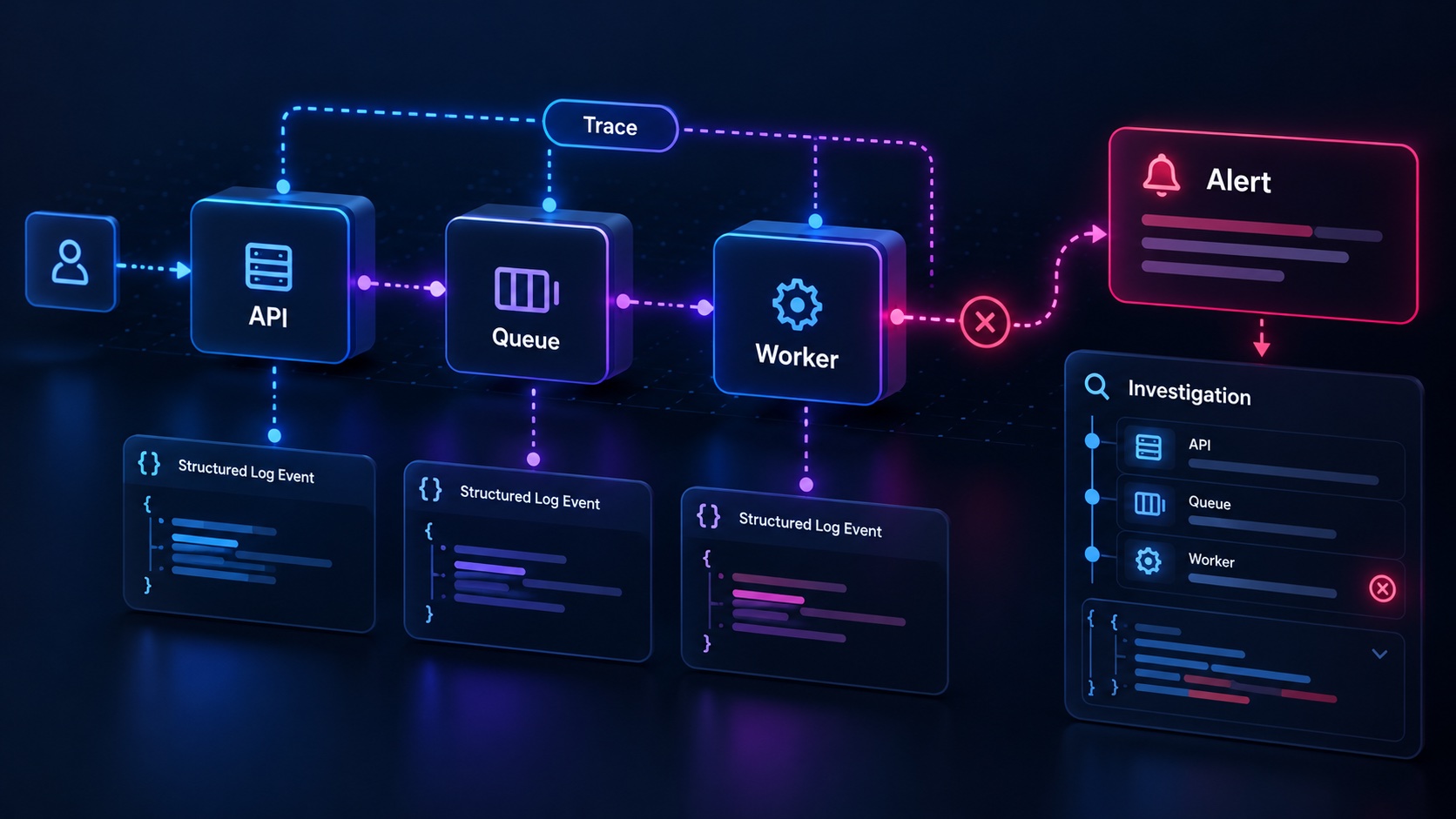
SaaS error monitoring should make a customer failure explainable. When someone says an export never arrived, you need to identify the workspace, follow the request into the background job, discover the failed step, and choose a safe recovery. A collection of stack traces alone rarely answers that whole question.
Start with consistent structured logs and a few alerts tied to important customer outcomes. Add more telemetry when a specific blind spot justifies it. Small teams benefit from an operational view they understand and can maintain during an incident.
Separate logs, errors, and service health
Logs record events and context. Error tracking groups exceptions and helps identify where code failed. Metrics summarize behavior over time, such as completed jobs or failed requests. A trace can connect work across multiple operations. These signals overlap, but each has a different role in an investigation.
An exception may be handled successfully through a retry. A business workflow can also fail without throwing an exception, such as an export that remains pending indefinitely. Monitor the outcome your customer expects instead of assuming every important problem appears as an application crash.
Choose one or two important workflows first. Describe what success means, where it is persisted, and which delays deserve attention. This gives your alerts a purpose and prevents every warning from becoming an interruption.
Adopt a small event schema
Use predictable fields such as event name, timestamp, severity, environment, service, release identifier, request identifier, and outcome. Add a workspace identifier when relevant and appropriate for the access controls of your logging system. Prefer stable codes for error categories and a readable message for human investigation.
The OpenTelemetry log data model defines fields for timestamps, severity, trace context, and additional attributes. You can use that structure as a reference even if your application initially emits straightforward JSON logs to one provider.
Distinguish an event's identity from its prose. An event named export.delivery_failed remains searchable when an explanatory message changes. A provider error category can support grouping without placing the full provider response in every record. Keep a short dictionary so developers use fields consistently.
Carry context across boundaries
A request identifier is useful only if it follows the work. When a web request creates a job, carry a correlation identifier into the job payload or durable job record. Store the job identifier in the request's completion event. Provider calls should include your local operation identifier in their associated logs.
For retries, preserve the logical operation identifier while giving each attempt its own attempt number or identifier. This lets an operator distinguish one export attempted several times from several exports requested independently. Record both scheduled and completed events where the distinction matters.
Do not make logs the only source of business state. Persist export status, retry eligibility, and delivery outcome in application records that can drive the UI. Logs explain how the state changed; customers and recovery code need a dependable state model even if a logging provider is unavailable.
Work through an export failure
Imagine a hypothetical document review product. A customer requests an export, receives a confirmation, and reports that nothing arrived. The request log shows successful job creation. The job log shows file generation succeeded, followed by a delivery failure classified as a temporary email provider error.
The operator can now inspect whether the delivery attempt will retry and whether sending again could create a duplicate. A recovery action should operate on the stored export job, preserve its history, and record the new attempt. Asking the customer to repeat the entire workflow may create unnecessary work and confusion.
Now consider another case: the job never started. The same investigation should reveal a created job with no execution event and a growing queue age. An exception alert alone would miss this. A monitor for old pending jobs covers the gap without adding instrumentation to every function.
Limit the data you collect
Define allowed log properties for common events. Error handlers often receive objects containing authorization headers, customer content, or provider credentials. Extract the fields you need and redact sensitive values before sending them to a logging service.
Apply the same discipline to screenshots, browser recordings, and attachments in error tools. A helpful diagnostic feature can capture more customer data than a small team intends to retain. Review access, retention, deletion, and export behavior for the system as a whole.
Avoid an unbounded number of arbitrary values in metric labels. Detailed identifiers belong in searchable event context; a metric usually needs manageable categories such as operation and outcome. Decide how to sample repetitive routine events while retaining the evidence necessary for critical failures.
Alert on an action someone can take
Every alert should have an owner, an explanation of customer impact, and an initial investigation path. A billing synchronization failure deserves different treatment from a rejected invalid form submission. An alert that wakes someone should identify a condition requiring prompt intervention.
Use thresholds suited to your traffic and workflow. With an early product, a count of affected paying workspaces may be more meaningful than a percentage based on a handful of requests. Treat any numerical threshold as a local operating choice and revise it after observing real behavior.
Keep a compact investigation record
After recovery, write down what failed, which customers were affected, how you recovered, and the change that will prevent or detect recurrence. Add a test when it captures the failure mechanism; improve the log schema when the investigation lacked necessary context.
Agentium Start lists Winston structured logging in its published implementation scope. Use that foundation to establish consistent events, then connect your own customer workflows to monitoring and recovery actions your team can actually operate.
Authority References & Sources: