
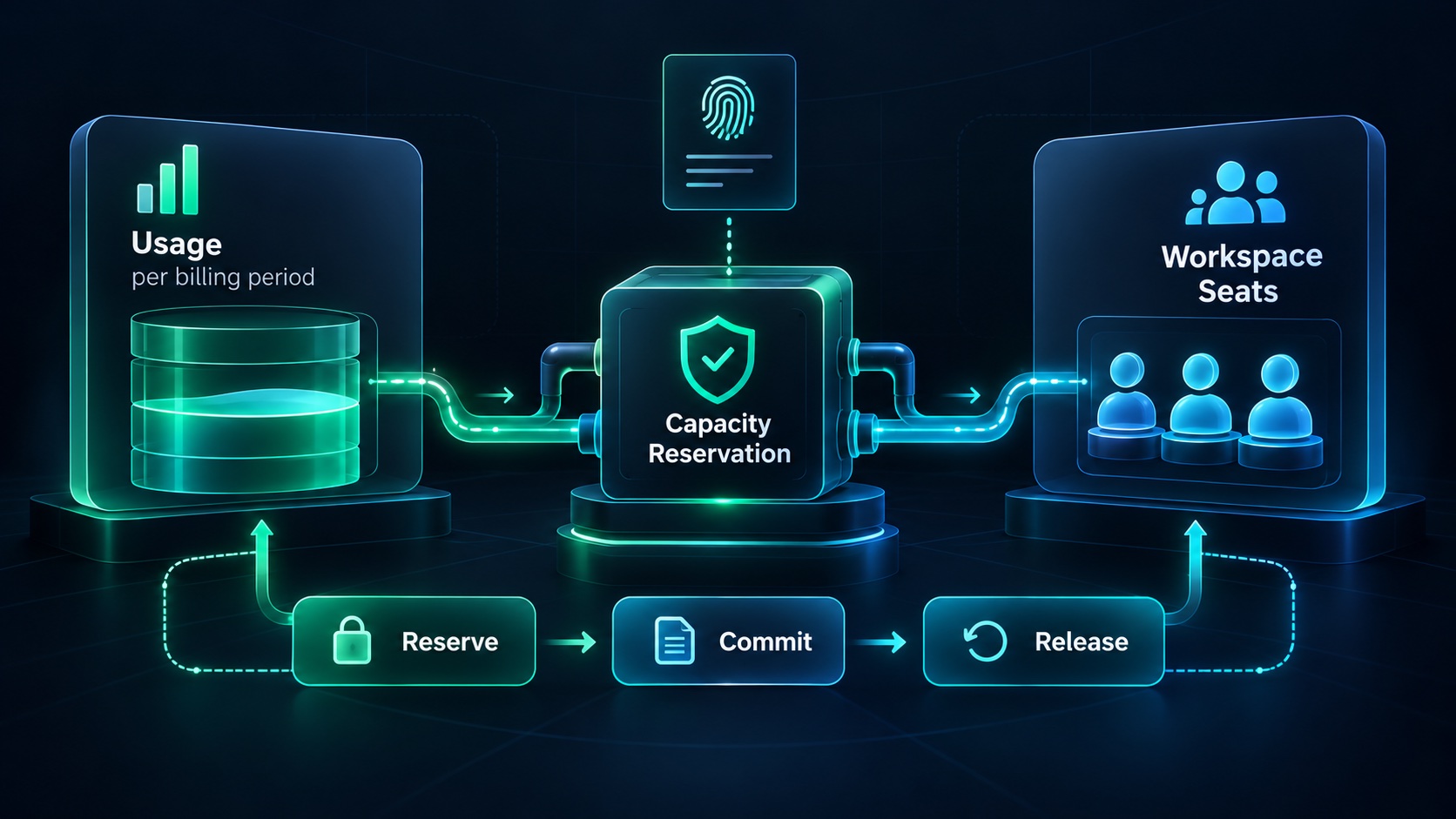
SaaS usage quotas should define exactly what is counted, when capacity is consumed and how the application prevents concurrent requests from exceeding the limit. A counter displayed on the billing page is only the visible part of that design.
Start with a written counting rule. If a plan includes document conversions, does one unit mean an upload, a processing attempt or one completed conversion? Customers and developers need the same answer before pricing, dashboards and enforcement can agree.
Define the unit and its lifecycle
Consider a hypothetical file conversion service. Its illustrative plan includes 100 completed conversions per billing period. Uploading a file does not consume a unit, a failed conversion returns reserved capacity, and downloading the completed result does not consume another unit.
That policy creates a lifecycle: requested, reserved, processing, completed or failed. It also clarifies a retry. Retrying the same operation after a network interruption should return or resume the existing conversion rather than charge another unit automatically.
Some products reasonably charge for attempted processing because external costs are incurred even when the output is unusable. If that is your model, say so clearly. The engineering design should enforce the stated business rule instead of assuming every failure deserves a refund.
Define distinct units separately. Storage capacity, active projects, team seats and monthly conversions have different lifecycles and should not share an ambiguous usage field.
Separate quotas from request rate limits
A quota limits cumulative consumption over a defined scope or period. A rate limit controls how quickly requests arrive. A concurrency limit controls how many operations can run at once.
The conversion service might allow a customer to use their entire allowance in one afternoon while limiting simultaneous processing to protect worker capacity. Those decisions are compatible because they answer different questions.
Use different error explanations. Quota exhaustion may require waiting for a new period or purchasing more capacity. A rate limit may allow another attempt shortly. A concurrency limit may place work in a queue.
Avoid treating a queue as unlimited permission to consume future resources. If work will consume a finite allowance, decide whether admission reserves capacity or whether queued requests may later be rejected.
Reserve capacity atomically
Suppose the customer has one conversion remaining and submits two requests at the same time. Both requests can read the same remaining balance before either writes an update.
A separate read-then-increment sequence therefore needs concurrency control. Use an atomic conditional update, a correctly designed transaction with locking, or an equivalent operation that coordinates admission. PostgreSQL's transaction isolation documentation explains why concurrent reads and writes require intentional handling.
A useful model tracks committed usage and reserved usage. Admit new work only if the requested reservation fits within the applicable limit. After processing, convert the reservation to committed usage or release it according to policy.
Keep reservation and job creation consistent. A crash should not leave capacity permanently reserved for a job that never existed, or create work that was never admitted. Expired or abandoned reservations need a recovery process.
Give each operation a durable identity
An operation identifier lets the application recognize retries across the browser, API and worker. Associate the usage entry with that identifier and the workspace.
Database uniqueness can help prevent duplicate usage entries. PostgreSQL's constraint documentation describes unique constraints that can cover several columns, useful for expressing a rule such as one usage entry per workspace and operation.
Choose the business identity carefully. A new retry attempt should not receive a new chargeable identity. A genuinely new conversion should not accidentally reuse an old one and escape accounting.
If a worker times out after the external conversion succeeded, investigate or recover the existing result before launching and billing another conversion. Usage accounting and external side effects must be designed together.
Bind consumption to a specific period
A monthly quota needs an explicit period definition. Calendar months and subscription billing periods are different choices. Record the relevant start, end and timezone or timestamp convention.
Avoid resetting a shared counter and assuming every later completion belongs to the new period. A job can start shortly before the boundary and finish afterward.
For the conversion example, you could bind the reservation to the period in which work was admitted. Completion then updates that same period. Another policy may fit a different product, but delayed jobs should not make the result accidental.
Handle upgrades and add-ons deliberately. Increasing capacity should record the change to the entitlement or allowance. A downgrade should define what happens when existing committed and reserved usage already exceeds the new limit.
Count seats according to a visible policy
Seats are a resource limit with human consequences. Define whether active members, pending invitations, suspended users and service accounts count.
A team with an illustrative five-seat plan might have four active members and one reserved invitation. If the invitation consumes capacity, display that distinction. If it does not, verify capacity atomically when the recipient accepts.
Removing a member should have a defined effect on available seats and any billing adjustment. Do not assume those changes share the same effective time.
Also decide whether the last available seat can be consumed through several entry points. An administrator screen, invitation acceptance and external provisioning integration must use the same capacity operation.
Explain usage and verify the edge cases
Show the current limit, committed usage, reserved usage when meaningful and the next reset or renewal date. A customer should be able to reconcile the numbers with their recent activity.
Provide useful recovery actions for stalled work. An operator may need to release an abandoned reservation, but that action should preserve a reason and avoid changing completed usage without explanation.
Test simultaneous requests for the final unit, duplicate job execution, failure after reservation, period rollover and several invitations competing for the final seat. Verify both the stored totals and the customer-facing result.
The Agentium Start feature list marks seat and resource limits as partial. Use its published scope to plan the remaining policy and enforcement work before selling a plan whose economics depend on hard limits.
Authority References & Sources: