
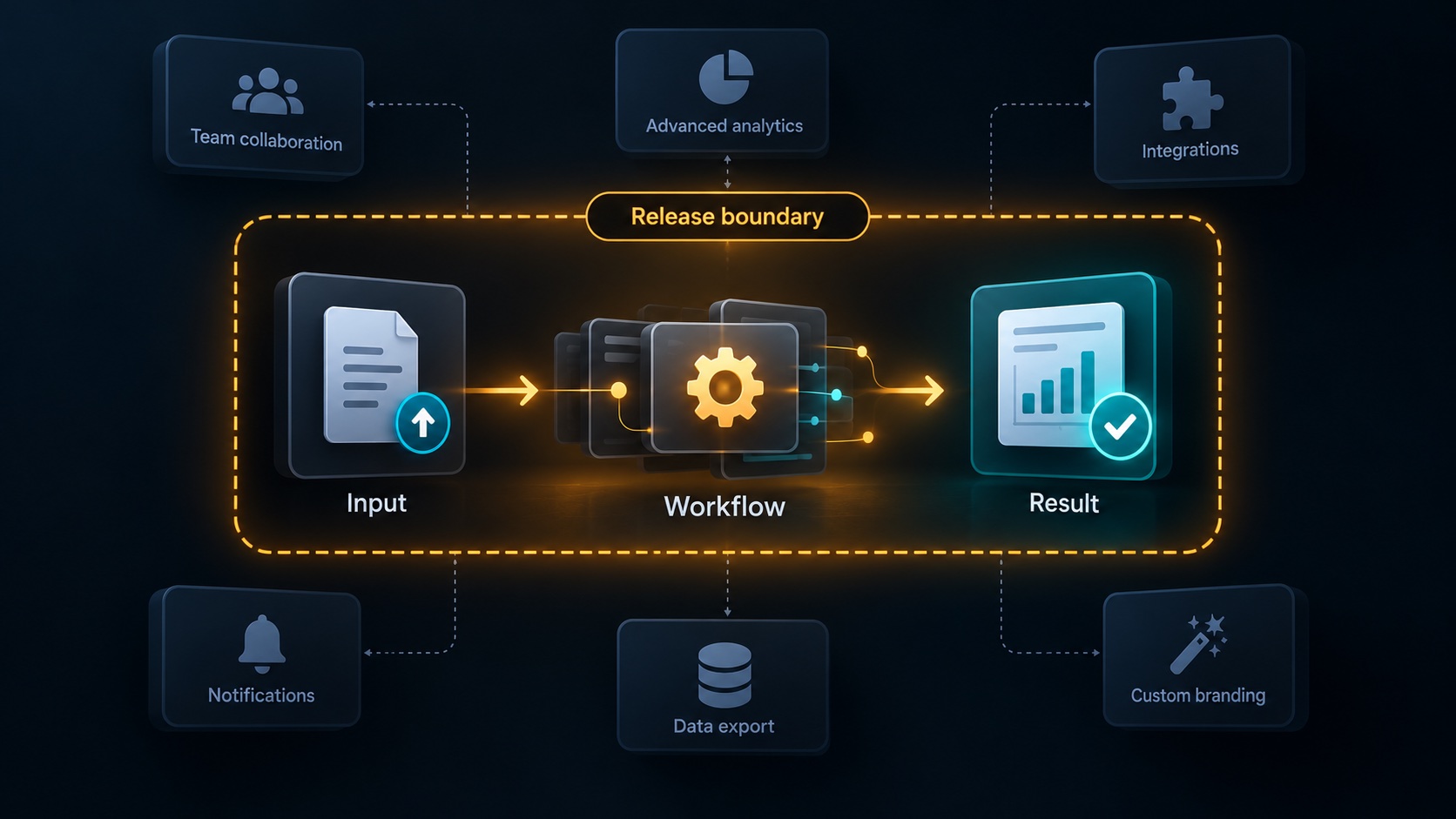
Scope a SaaS MVP by selecting one valuable workflow and making it complete enough for a customer to use. The minimum should remove unnecessary breadth while preserving the steps, access rules, and exceptional cases that make the promised outcome dependable. A smaller feature list helps only when customers can still finish the job they purchased.
Begin with a sentence that connects a user, a task, and a result. Then use that sentence to decide what belongs in the release and what should wait.
Write the purchase reason in plain language
Consider a hypothetical product for small custom furniture workshops. The owner wants customers to review a quotation, choose a finish, and accept the final specification before production starts. The purchase reason is a clearer record of what was agreed.
That purpose is narrower than “a complete furniture business platform.” It does not immediately require inventory, staff scheduling, a supplier marketplace, or generative room design. Those may become opportunities later, but they do not belong automatically in the initial commitment.
Ask the buyer what makes the current process difficult. If disputes arise because customers approve an outdated attachment, version clarity matters. If the main problem is unanswered quotations, follow-up visibility may matter more. The MVP should follow observed friction rather than the founder's preferred feature category.
Draw the beginning and end of the workflow
Define the trigger, required information, decisions, and completion condition. For the furniture workshop, the process begins when a draft quotation is ready for customer review. It ends when the customer accepts a specific version with an identifiable set of choices.
Map the intermediate steps: the workshop prepares the quotation, shares it, receives requested changes, publishes a revised version, and records acceptance. Decide which party can perform each action and which state changes are valid.
This map should be small enough to explain without describing the entire application. It becomes the basis for interface design, data relationships, event tracking, and release checks. When a requested feature does not fit the map, ask which customer problem it resolves before adding it.
Keep the exceptions that preserve the promise
Some edge cases are central to the paid outcome. If an old quotation link can approve a superseded version, the product fails its purpose even if most customers never encounter that path. If the wrong customer can read a quotation, the problem is more serious than a missing convenience.
Distinguish these essential exceptions from optional flexibility. Expired links, withdrawn quotations, and duplicate acceptance attempts deserve a decision. Supporting every possible document layout or dozens of approval hierarchies may be deferred.
Specify the response in customer language. A superseded quotation should say that a newer version is available and guide the authorized customer to it. A duplicate acceptance should show the existing result clearly. These decisions make the workflow complete without making the scope broad.
Separate the foundation from the domain
The furniture workflow needs a place for the workshop's team, a way to sign in, appropriate access, and an operating application. It also needs domain-specific quotation versions, finishes, review comments, and acceptance rules.
A SaaS foundation can supply some of the first group. Agentium Start's capability page describes workspace and membership code, roles, onboarding, reference CRUD, and billing components. The quotation workflow still requires its own model and behavior.
This separation helps estimate work honestly. Do not count a generic task screen as a finished quotation process. Equally, avoid rebuilding reusable account and workspace concepts merely because the business object is new. Keep the distinctive logic in a clear part of the codebase so the foundation remains understandable.
Use acceptance criteria to control additions
Write acceptance criteria as observable outcomes. An authorized workshop member can publish a quotation version. The customer can view the intended details. A requested change creates a traceable revision. Acceptance identifies the exact version. A withdrawn quotation cannot be newly accepted.
Include one or two examples for ambiguous rules. If a customer chooses a different finish after acceptance, does the system reopen the quotation or create a new revision? Decide before implementation instead of letting the database schema answer accidentally.
When someone proposes a new feature, assess whether it helps meet an existing criterion, resolves a recurring failure, or tests a new purchase assumption. If none applies, place it in a later opportunity list. This gives you a reasoned way to defer work without losing the idea.
Choose the smallest useful delivery method
Early delivery can include some human assistance where that arrangement is explicit and manageable. For instance, you might help the first workshops import their existing quotation items instead of building a complex migration interface.
Keep human assistance away from hidden correctness requirements. Manually repairing every approval record would undermine the product's main promise. The important distinction is whether the assistance supports onboarding or substitutes for the dependable behavior customers believe they have bought.
Explain the initial scope to customers before they rely on it. Use their first real quotations to check whether the selected workflow matches how they work. Observe exceptions and confusion rather than asking only whether they like the design.
Finish with a release boundary
Write a concise release boundary containing the supported user, the completed workflow, the essential exceptions, and the deliberately deferred features. Add evidence for each acceptance criterion and the operating responsibility for customer issues.
Then release that bounded product and learn whether customers continue using the outcome. Expansion should follow a demonstrated adjacent need, such as managing repeat orders, rather than the availability of another component.
Review the Agentium Start source kit if reusable B2B foundations fit your plan. Let the kit support the application while your MVP stays focused on the one workflow a customer has a reason to buy.
Authority References & Sources: