
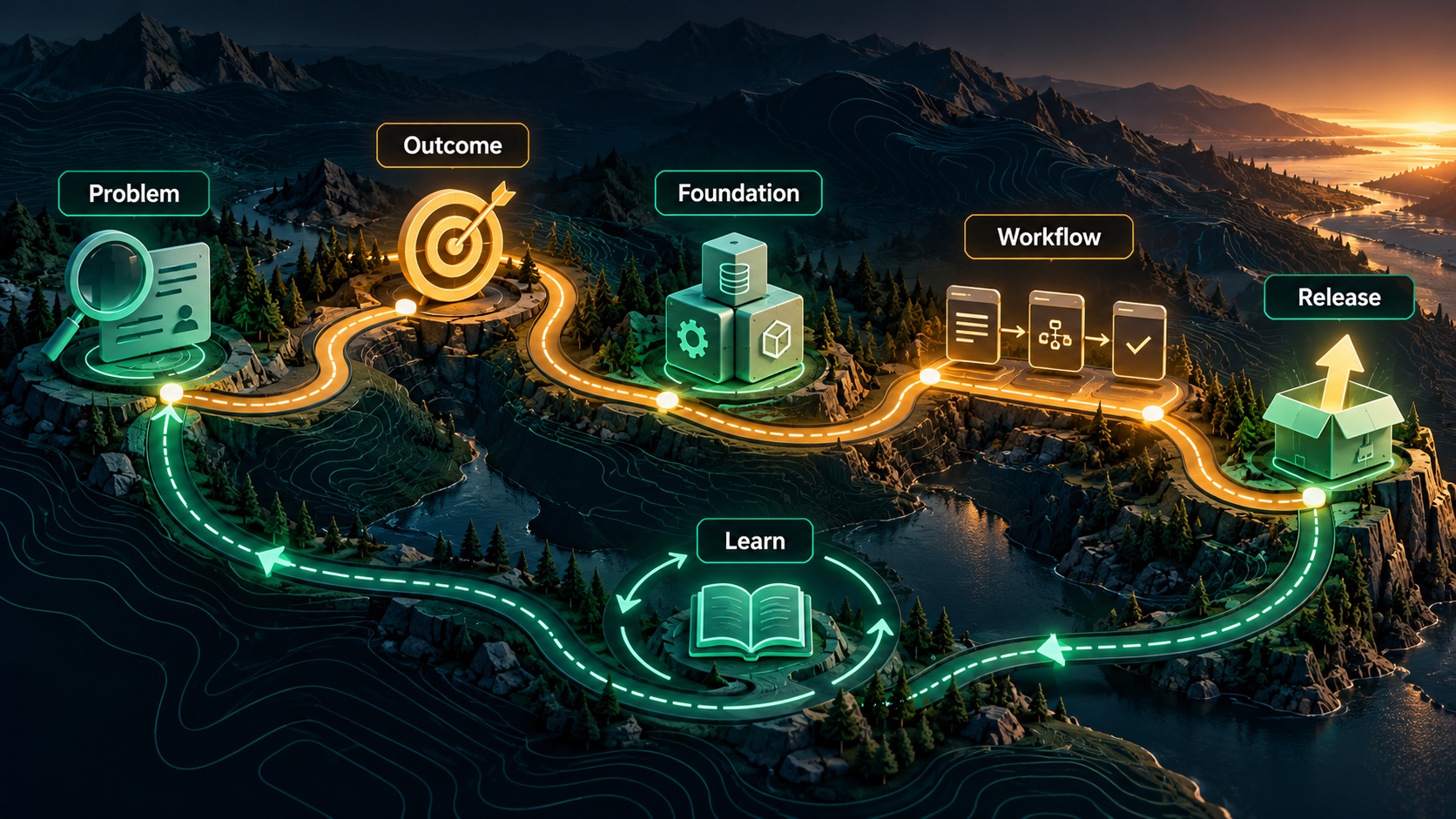
A solo founder SaaS roadmap should sequence uncertainty before implementation and protect time for operating the product after launch. Start by identifying a recurring customer problem, narrow the first paid workflow, and build the minimum complete application that delivers it. Judge progress by evidence of a useful result rather than by the number of screens completed.
If you also have another job or commitments, plan around the hours you can sustain during an ordinary week. A roadmap that depends on repeated late-night rescues is difficult to maintain once customers begin needing help.
Establish the problem before the backlog
Choose a specific type of organization and a recognizable task. “Software for small businesses” gives you little guidance. “Helping equipment rental shops track items that need inspection before the next booking” gives you actors, records, and an operational consequence.
Speak with potential users about the most recent time they completed that task. Ask what started it, where information was stored, who was involved, and what happened when something was missed. Request a walkthrough of the existing process when they can share one appropriately.
Record observations separately from your proposed solution. A request for a dashboard may reflect difficulty finding overdue work; the actual need might be a dependable queue and notification. Your first milestone is a problem statement with an identifiable buyer and a clear consequence.
Define one outcome someone can buy
Write the result in the customer's language. For the hypothetical rental shop, the outcome could be knowing which returned items are cleared for the next rental and which need attention. That is more useful than a backlog containing tags, analytics, themes, and AI summaries.
Define the beginning and end of the workflow. An item is returned, an employee records its condition, a responsible person completes an inspection, and the item becomes available again. Specify the exceptional state when the inspection fails.
Describe an initial offer with a bounded scope and a clear support arrangement. Early customer conversations should test whether the workflow has enough value to justify payment. They should also expose requirements you cannot responsibly promise within the first release.
Reserve capacity for foundation work
Identify the common application functions that support the workflow: identity, customer accounts, permissions, billing, emails, storage, and operating visibility. Decide which you can reuse and which must be configured or built.
An editable foundation can make this work more organized. Agentium Start's feature scope includes implemented workspace, role, billing, and application-shell capabilities, with other areas labeled according to their current depth. Compare these capabilities with your launch requirements before adopting its structure.
Budget time to understand the code you will maintain. Reuse is most helpful when you can explain how an action reaches the database, where access is checked, and how errors are surfaced. Treat unfamiliar foundations as something to inspect, rather than an excuse to skip engineering ownership.
Build one complete workflow
Implement the rental inspection path from sign-in to a recorded result. Include a useful empty state, a working input form, validation, authorized state changes, and a way to find unfinished work. The first version can have a modest interface while still completing the real task.
Use two fictional rental companies to check that their items remain separate. Add another member to one company and verify the intended division of responsibility. Include an interrupted action and an invalid state transition.
Keep a short demonstration script you can repeat after meaningful changes. It should show the actual outcome rather than a tour of settings pages. A complete slice of functionality gives customer conversations something concrete and exposes integration problems early.
Prepare the application for a small paid release
Before accepting reliance on the product, verify the deployed workflow, provider configuration, customer communications, and a way to recover from a failed operation. The Next.js production checklist offers a framework-specific reference for reviewing production behavior; select the items relevant to your application.
Write a short operator note covering where failures appear, how to identify an affected workspace, and what to do if the application must be temporarily restricted. Prepare a direct support route and an honest description of the first release's scope.
A small customer group allows you to observe usage closely, but it does not remove the need for customer isolation or trustworthy records. Adjust the release size to what you can support and the consequences of failures.
Run the roadmap as a weekly cycle
Use a simple weekly allocation that leaves room for discovery, delivery, and operations. As an illustrative plan, a founder with five available hours could spend one hour with customers, three on the next important change, and one on review and support. This is a planning example, not a universal productivity formula.
Choose one outcome for the week and define the evidence that will finish it. “Add inspections” is vague. “A shop employee can submit a condition report and a manager can record a clearance decision” is reviewable.
After release, study where customers stop, which questions recur, and whether they return to complete the workflow. Prioritize problems that block the purchased outcome before adding adjacent features.
If you need a reusable starting point for this sequence, review the Agentium Start documentation. Keep the roadmap narrow enough that one founder can build, learn, and respond to customers without losing control of the application.
Authority References & Sources: