
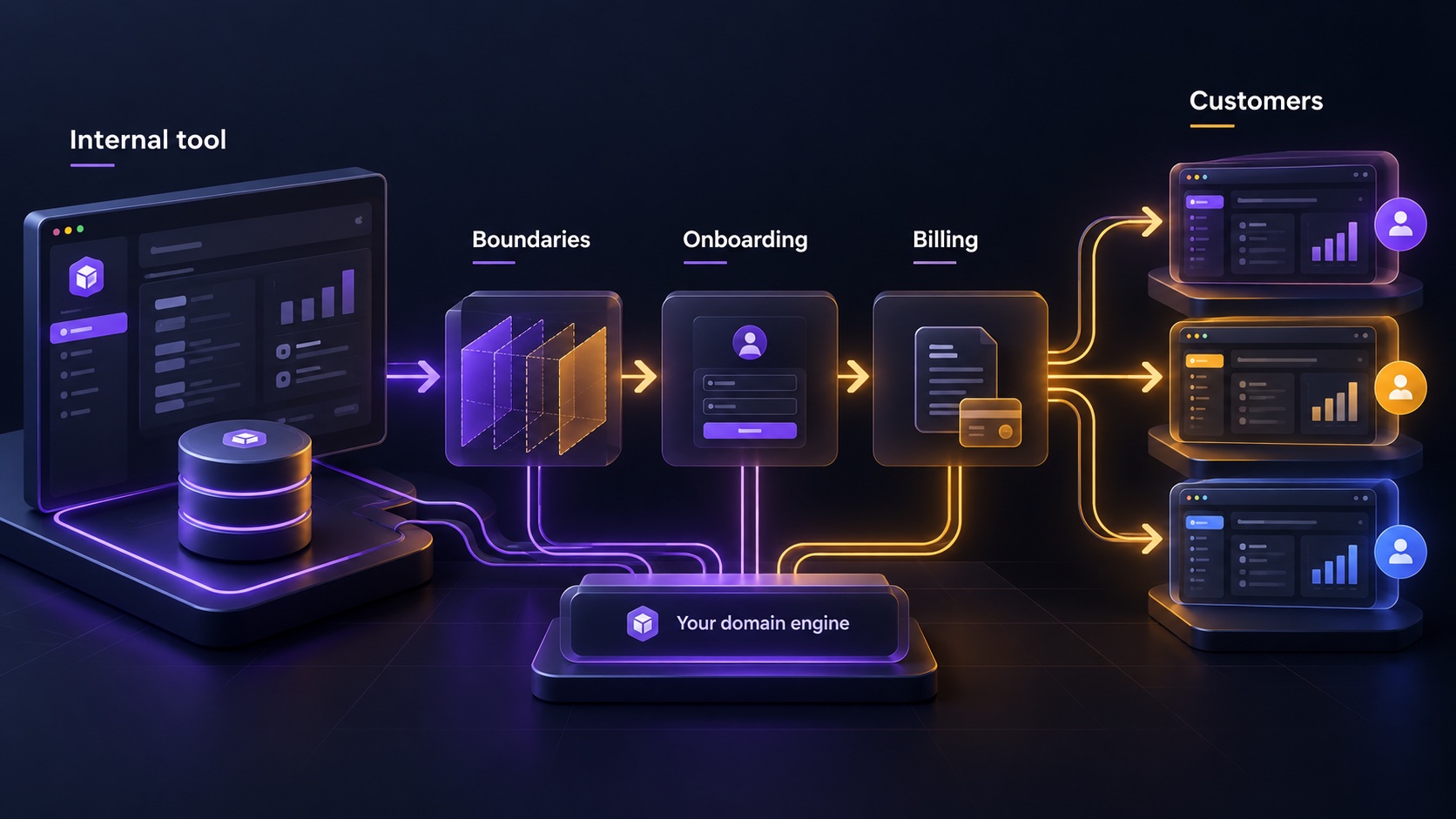
An internal tool becomes a SaaS product when another organization can use it to solve a recurring problem without depending on your company's people, data, or unwritten procedures. The existing workflow may provide a valuable starting point. Productization means identifying that value and rebuilding the surrounding assumptions into explicit product behavior.
Begin with a narrow external customer and a complete paid workflow. Avoid treating every feature used internally as something the market will want. Some features exist only because of the original organization's structure or historical workarounds.
Find the portable problem
Describe the business job without referring to your internal application. A service team might need to collect evidence, assign a reviewer, resolve missing information, and record approval. Those steps may matter to other organizations even if your tool's original departments and labels do not.
Speak with potential customers about their current process, recent failures, and the consequences of those failures. Ask them to show the documents and handoffs they use, with appropriate permission. A statement that the tool looks useful is weaker evidence than a clear recurring problem and willingness to evaluate it in real work.
Choose the first segment where the process is similar enough to support one product. If one prospect needs sales forecasting and another needs safety inspections, shared form components do not necessarily make them the same opportunity. Look for a common job and buying reason.
Expose the hidden assumptions
Inventory hardcoded company names, email domains, approval thresholds, department lists, integrations, and privileged users. Look for assumptions in database queries and background jobs as well as the visible interface. A tool can appear configurable while still reading one shared folder or sending every notification to an internal address.
Separate deployment configuration from product settings. The Twelve-Factor App's configuration guidance distinguishes settings that vary between deployments from internal code structure. For a SaaS product, also identify settings that legitimately vary by customer workspace and need validated, authorized editing.
Do not turn every internal constant into a customer setting. Too much configuration makes onboarding difficult and expands the states you must support. Keep a stable default process, then expose variations that the chosen customer segment actually needs.
Work through a supplier approval tool
Imagine a hypothetical company using an internal tool to approve supplier documents. Every request goes to one purchasing manager, uses the company's fixed document categories, and stores files in a shared internal bucket. The workflow is valuable, but another organization cannot safely adopt it as-is.
The first SaaS version could let a workspace define its reviewers, submit supplier records, request missing documents, and record an approval decision. It does not need to reproduce every internal report. Its initial promise is a complete, understandable supplier review process.
Before a pilot, replace the global reviewer with workspace-specific membership and permissions. Give each supplier record and file an explicit workspace owner. Define how a reviewer sees pending work and how a requester receives the outcome. Remove company-specific notification destinations from every path.
The example shows why changing branding is only a small part of productization. The main work is making data ownership, responsibility, and process rules explicit enough for independent customers.
Add customer boundaries and lifecycle
External customers need isolated records, account ownership, invitations, role changes, and a way to leave. Decide whether a person can belong to several workspaces and which workspace owns the subscription. Keep user identity separate from organization membership.
Review all access paths: dashboards, search, exports, uploaded files, scheduled tasks, and administrative tools. An internal application may have relied on everyone being a trusted colleague. A SaaS application needs to enforce who can access each resource and action.
Define account lifecycle behavior before the first paid commitment. Consider a departing owner, a removed employee, a canceled subscription, and a customer requesting an export of their own records. These situations should have supported procedures instead of requiring improvised direct database edits.
Make setup and support independent
An internal tool often succeeds because its creator sits nearby. External customers need clear instructions, meaningful empty states, understandable errors, and a support path. Observe a new customer attempting the first workflow without explaining every screen.
Write down the minimum setup information and why each item is required. For the supplier tool, the first result might require one reviewer and one real supplier submission. Optional categories and advanced reporting can wait until the customer sees the process work.
Define support scope and availability in language you can consistently honor. Keep a record of repeated questions and manual interventions. Those reveal where the product needs clearer behavior or automation, and they help estimate the operational cost of serving another customer.
Validate a paid version before broad expansion
Offer a bounded pilot around the selected workflow, with clear expectations about capabilities, assistance, and duration. Agree on what a successful result looks like. A pilot should produce evidence about actual usage and value, not merely extend a series of demonstrations.
Choose a charging unit that reflects the workflow and is understandable to the buyer. That might be workspaces, active users, or a usage allowance. Evaluate whether the resulting revenue can support infrastructure, provider costs, onboarding, and support. Use your own observed costs instead of assuming internal usage was free.
Keep requests in a decision log. Some deserve general product features; some are better served through configuration; others belong outside the current scope. Building every prospect's preferred process can turn a focused SaaS into an unsustainable collection of bespoke tools.
Choose what to preserve
Retain domain logic that is correct, understandable, and relevant to the new customer. Replace assumptions that prevent isolation or independent operation. A full rewrite should have a concrete reason, such as a structure that cannot safely support the required boundaries, rather than being the automatic first step.
If the existing tool lacks the surrounding account and commercial foundation, assess Agentium Start against those needs. Keep the valuable workflow at the center and use the foundation to support a product another organization can adopt, operate, and pay for with clear expectations.
Authority References & Sources: